If you watched Dhurandhar Part 2: The Revenge this week and came home Googling “how to join RAW after graduation” at midnight, you are not alone. Lakhs of people are doing the exact same thing right now. And honestly, that says more about Aditya Dhar’s filmmaking than any review ever could.
The problem is that most articles on this topic are either vague, copy-pasted from each other, or just flat-out wrong. So this is a proper breakdown of what actually happens when someone in India tries to build a career in intelligence, what the real pathways are, and what you as a student or fresh graduate can do starting today.
What is RAW and Why Does Dhurandhar Get It Mostly Right:-
RAW stands for Research and Analysis Wing. It is India’s external intelligence agency, founded in 1968 by Prime Minister Indira Gandhi. The reason it was created at all goes back to the intelligence failures during the 1962 Sino-Indian War and the 1965 war with Pakistan. Those two conflicts made it painfully obvious that India needed a dedicated foreign intelligence setup that was separate from the Intelligence Bureau, which until then was managing both domestic and foreign intelligence at the same time.
Today, RAW reports directly to the Prime Minister’s Office. Not to any ministry, not to Parliament, and not to any public oversight body. That level of secrecy is not cinematic fiction. It is by design and it is very much real.
In Dhurandhar, R. Madhavan plays Ajay Sanyal, the head of the Intelligence Bureau who runs a covert operation inside Pakistan. The character is widely understood to be inspired by Ajit Doval, India’s National Security Advisor, who served as Director of the Intelligence Bureau between 2004 and 2005. Whether Doval or someone in that position actually ran such operations is something that will never be officially confirmed. But the character’s worldview in the film captures the kind of strategic thinking that real intelligence doctrine is built on.
Ranveer Singh’s character Hamza Ali Mazari, whose real identity is revealed as Jaskirat Singh Rangi, is not based on any single real person. The makers had to clarify this publicly after Major Mohit Sharma’s family approached the Delhi High Court before Part 1 released, concerned that the story was using their son’s life without consent. Director Aditya Dhar confirmed that the character is a composite, built from the tactics and psychological profiles of multiple Para-SF and RAW operatives who have carried out long-term undercover missions over the years.
The setting, however, is very real. Operation Lyari was a prolonged crackdown on gang networks in Karachi’s Lyari district that stretched from 2012 to 2017. The film uses this as its primary backdrop. Other real events layered into the Dhurandhar universe include the 1999 IC-814 Kandahar hijacking, the 2001 Parliament attack, the 2008 Mumbai attacks, and the 2016 demonetisation, which Part 2 specifically connects to counterfeit Indian currency networks operating out of Pakistan.
The research that went into this film is serious, and that is exactly why it feels as grounded as it does.
The Honest Truth: There Is No Direct Recruitment for RAW
Let us get the most important thing out of the way first, because every other article either buries this or avoids it entirely.
You cannot apply to RAW. There is no application form. There is no RAW entrance exam. There is no RAW.gov.in recruitment page. The agency has never advertised a single opening to the public and it never will. If someone on YouTube or Telegram is claiming they have a “direct link” to apply for RAW, close that tab immediately.
RAW operates under the Cabinet Secretariat and recruits through internal, classified channels. The real paths into the agency are fewer than most people assume, but they do exist. Here is what they actually are.
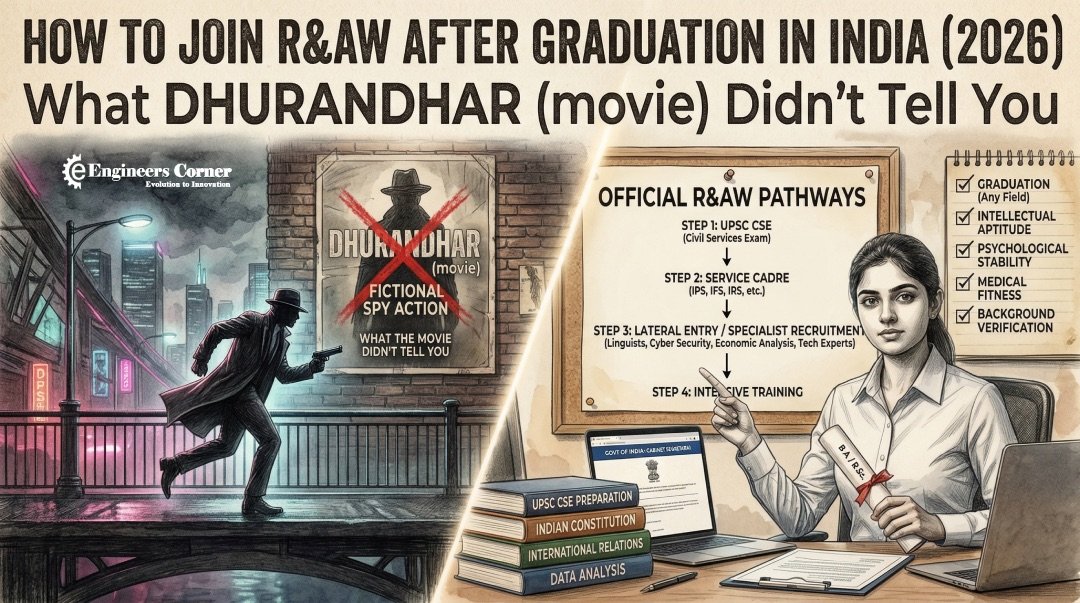
The 4 Real Pathways to Joining RAW
1. Crack UPSC and Aim for IAS, IPS or IFS
This is the most structured and most reliable route. Every year, top-performing candidates from the UPSC Civil Services Examination are inducted into services like IAS, IPS, IRS, and IFS. At the Foundation Course at the Lal Bahadur Shastri National Academy of Administration (LBSNAA) in Mussoorie, RAW conducts a confidential campus-level interview of select candidates. Based on psychological assessments and interviews, some officers are offered a one-year stint in the Research and Analysis Service (RAS). Those who perform well during that year are permanently absorbed into RAW.
The key thing to understand here: these are not just good candidates. They are typically in the top percentile of UPSC rankers, evaluated heavily on psychological stability, geopolitical thinking, language ability, and discretion. A UPSC rank of 500 likely does not get you into that room. You need to be genuinely exceptional in a very specific way.
Most of RAW’s senior leadership has historically come through IPS and IFS.
2. Join the Armed Forces via NDA, CDS, or AFCAT
Military intelligence is one of RAW’s most consistent talent pipelines. Officers from the Indian Army, Navy, and Air Force, especially those from special forces units, are regularly deputed to RAW on both short-term and permanent bases. If you are in the Army’s Para Special Forces and your service record and psychological profile meet what RAW looks for, you may be considered.
But here is the thing about this route: you do not apply. Your superiors assess you over years of service, your record builds your case, and RAW comes to you. This is not something you can engineer from the outside.
3. Join the Intelligence Bureau First (The IB ACIO Route)
This is the most realistic path for a fresh graduate who genuinely wants to work in Indian intelligence. The Intelligence Bureau is India’s domestic intelligence agency and was historically the parent organisation from which RAW itself was carved out in 1968. Many RAW officers can trace their careers back to the IB.
The IB runs a public examination called IB ACIO, short for Assistant Central Intelligence Officer, Grade II/Executive. This is a real exam, run by the Ministry of Home Affairs, with real vacancies that are publicly notified. The 2025 cycle had 3,717 vacancies. If that sounds like a lot, keep in mind the competition is in the hundreds of thousands.
IB ACIO Eligibility 2026 (Expected, based on previous cycles):
- Nationality: Indian citizen only
- Age: 18 to 27 years. Relaxation applies for OBC, SC/ST, and Ex-Servicemen candidates as per government norms
- Education: Graduation or equivalent from any recognised university
- Stream: No restriction. Science, arts, commerce, engineering, all are eligible
IB ACIO Selection Process:
- Tier 1: 100-mark objective MCQ paper covering General Studies, Current Affairs, Reasoning, Numerical Aptitude, and English
- Tier 2: 50-mark descriptive test covering essay writing, English comprehension, and current affairs analysis
- Interview / Personality Test: 100 marks. This round tests alertness, analytical thinking, communication ability, and overall suitability for intelligence work
IB ACIO Salary: The pay scale sits at Level 7 of the 7th Pay Commission, which is Rs 44,900 to Rs 1,42,400 per month. In-hand salary including all allowances works out to approximately Rs 80,000 to Rs 90,000 per month depending on your city of posting. There is also a Special Security Allowance of 20% of basic pay, which is separate from standard central government allowances.
The IB ACIO 2025 cycle is complete. Based on the pattern from 2025 (notification in July, Tier 1 exam in September), the IB ACIO 2026 notification is expected around mid-2026, most likely July or August, on the official Ministry of Home Affairs website at mha.gov.in
4. Lateral Recruitment for Specialists
RAW does recruit directly in some cases, but this is limited to specialists. Linguists who speak Arabic, Mandarin, Pashto, or Dari at close to a native level, and cybersecurity professionals with rare credentials, have been recruited directly in the past. This pathway is classified, extremely rare, and works the other way around. RAW finds you. You do not find RAW.
What Kind of Person Does RAW Actually Look For
Qualifications alone are never enough. There is a profile that intelligence agencies look for, and based on what is publicly known from former officers and defence research institutions, it comes down to a few consistent things.
Language skills are the single biggest differentiator. If you speak a strategic language at a high level, particularly Chinese, Arabic, Russian, Dari, Pashto, or Sinhala, your value to Indian intelligence increases significantly. This is something you can start working on right now, regardless of your academic stream.
Psychological stability is taken more seriously than most people expect. Intelligence work means sustained stress, moral ambiguity, long periods of isolation, and years of operating with zero public recognition. Candidates who are motivated by fame, validation, or attention tend to be filtered out at every stage. The psychological screening is thorough and it is not a formality.
Geopolitical awareness is tested directly at the IB ACIO Tier 2 level and at every interview stage that follows. If you are not regularly reading about China-Pakistan dynamics, India-Afghanistan relations, or the security situation in Myanmar, start doing that now. Not just to clear a test, but because it fundamentally changes how you process information and think about problems.
Clean background: Any criminal history, even something minor, is disqualifying. Background verification also covers immediate family members. There are no exceptions here.
Skills You Can Build as a Student Right Now:-
Whether you are in your second year of B.Com or midway through a B.Tech, there are concrete things you can do that genuinely strengthen your profile for any intelligence-linked career in government.
Read quality newspapers every day. Not just the headlines. Full articles on foreign policy, bilateral agreements, defence acquisitions, and major terrorism or security events. The Hindu and The Indian Express are both strong choices for UPSC and IB preparation.
Learn a foreign language seriously. Language apps are a starting point but not enough on their own. Look for structured certification courses. Jawaharlal Nehru University offers serious language programmes. For Arabic, there are several accredited online courses worth exploring.
Build a UPSC preparation base. Even if your primary goal is IB ACIO and not IAS, UPSC-level general studies covering Indian polity, history, international relations, and current affairs overlaps almost entirely with what IB tests. Time spent on this is never wasted.
Take physical fitness seriously. Intelligence and defence agencies at every level value physical discipline. More importantly, maintaining it consistently signals a kind of mental discipline that is harder to fake.
What Happens After You Are Recruited:-
RAW’s training setup is classified and very little is officially confirmed. From what is known through former officers and defence researchers, new recruits entering through the RAS route typically begin with an introductory phase in Delhi before moving into specialised modules covering foreign languages, information security, geopolitics, and field operations. A portion of advanced training involves the Indian Military Academy in Dehradun. Officers who come through the LBSNAA route spend one year on probation before being permanently absorbed.
Officers posted abroad live completely ordinary cover lives. One might be working at an Indian consulate as a trade attaché, another as a journalist or a researcher. The whole point is that nobody around them knows anything.
One Thing Dhurandhar Gets Exactly Right:-
There is a moment in the film where Ajay Sanyal tells Hamza that he was not chosen because he was the best soldier. He was chosen because he had nothing left to lose, and that made him the most dangerous kind of operative.
That is a cinematic line, but it points to something genuinely true about intelligence work. These agencies are not just looking for credentials. They are looking for a particular kind of person, someone who can completely disappear into a different identity, function without any external recognition, and serve the country in ways they will never be allowed to talk about publicly.
If that idea excites you more than it unsettles you, you are probably thinking about this the right way.
Frequently Asked Questions (FAQs):-
Q: Can I join RAW directly after 12th class?
No. RAW does not recruit at any level after 12th. The minimum educational requirement for any intelligence-related career in India is graduation. For IB ACIO, a graduation degree from a recognised university is mandatory. For UPSC-linked pathways, candidates typically serve in their service for years before being considered for RAW.
Q: Is there any RAW recruitment 2026 notification?
No. RAW does not release any public vacancy notification. It never has and it does not operate that way. The closest publicly accessible opportunity is the IB ACIO exam, conducted by the Ministry of Home Affairs.
Q: What is the salary of a RAW agent in India?
The government does not officially disclose RAW salary figures. Based on estimates from defence research institutions, entry-level RAW officers, typically IPS or IFS officers on deputation, earn somewhere between Rs 80,000 and Rs 1.3 lakh per month, including special allowances and foreign service benefits. Officers at the Joint Secretary level and above earn considerably more.
Q: Is Dhurandhar based on a true story?
It is not based on one specific true story, but it is heavily grounded in real events. Operation Lyari in Karachi (2012-2017), the 1999 IC-814 Kandahar hijacking, the 2001 Parliament attack, and the 2008 Mumbai attacks all feed into the film’s universe. Characters like Ajay Sanyal (inspired by Ajit Doval) and Rehman Dakait (inspired by Karachi gang leader Abdul Rehman Baloch) are based on real figures. Ranveer Singh’s Jaskirat Singh Rangi is a composite fictional character.
Q: What is the IB ACIO 2026 notification date?
The notification for IB ACIO 2026 has not been released yet. Going by the 2025 cycle, where the notification came out in July and the Tier 1 exam was held in September, the 2026 notification is expected around mid-2026 on mha.gov.in.
Q: Can IB ACIO officers eventually move into RAW?
Yes. Historically, a number of RAW officers started their careers in the Intelligence Bureau. IB ACIO is a genuine entry point into India’s broader intelligence structure, and high-performing IB officers can be considered for deputation or absorption into RAW over the course of their career.
Q: Which exam should I focus on to enter the intelligence sector after graduation?
Start with IB ACIO. It is the only publicly advertised examination that directly recruits into India’s intelligence setup. At the same time, build UPSC preparation in parallel, because clearing Civil Services and entering IPS or IFS significantly increases your chances of being deputed to RAW later in your career.
Final Word
Both parts of Dhurandhar are the kind of cinema that makes you want to do something bigger with your life. That is a mark of genuinely good filmmaking. But the actual path to serving in Indian intelligence is not a dramatic moment of being handpicked in some dark room. It is years of preparation, a clean and outstanding record, and a real willingness to work without anyone ever knowing what you did.
The good news is the path is real and it starts right where you are. Focus on IB ACIO and UPSC preparation, pick up a foreign language, read widely, stay disciplined, and build the kind of profile that makes you the right kind of person for this work. The rest, as they say, takes care of itself.