Let me be upfront with you this wasn’t some polished, perfectly-run event where everything went to plan.
People got stuck in traffic for four hours. A university got caught showing off a Chinese-made robot as their own invention. AI “godfathers” ended up delivering speeches over shaky video calls from embassies because the Delhi roads wouldn’t cooperate. One CEO skipped dinner with the PM entirely and ate room service at 11pm.
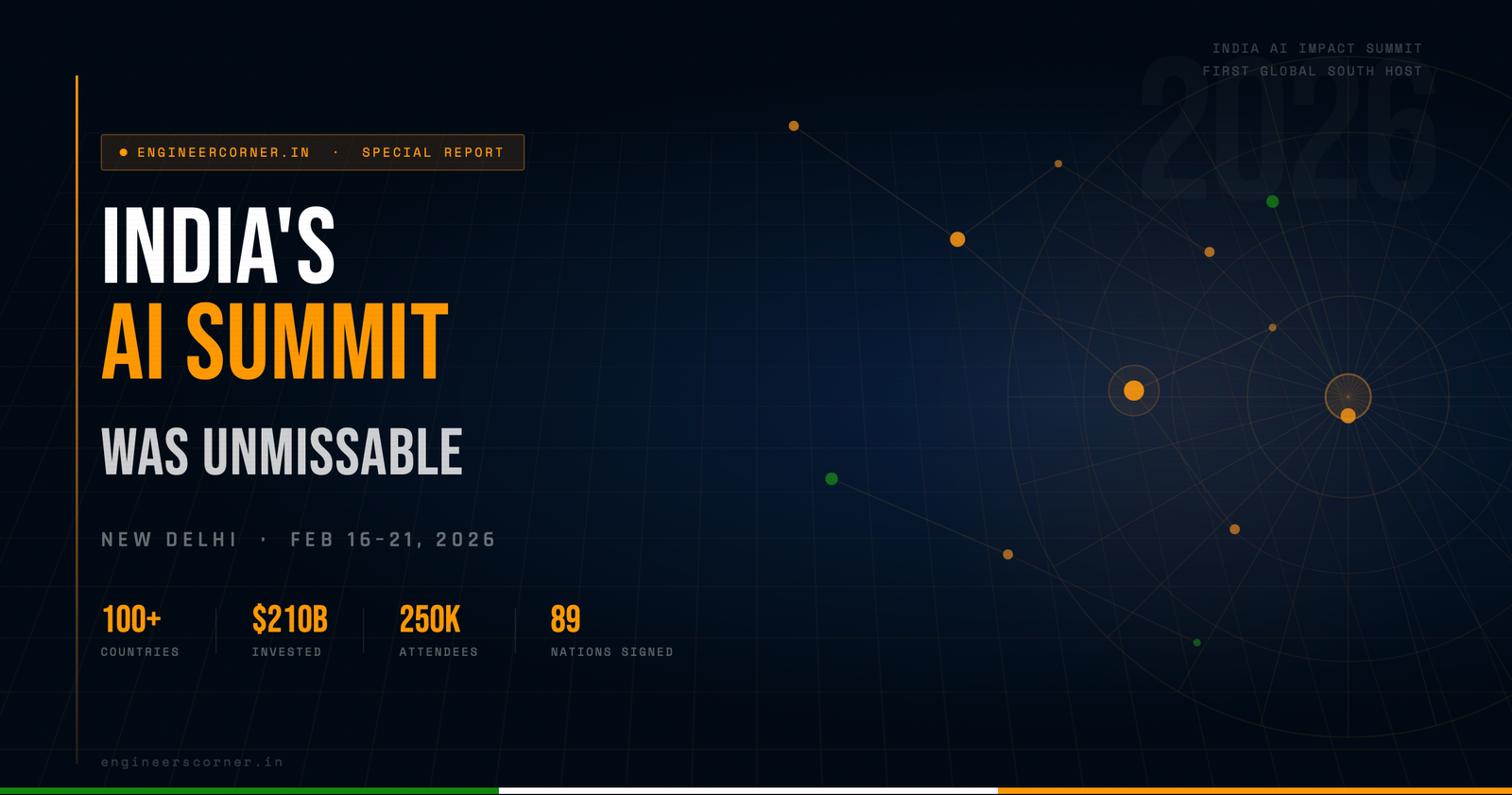
And yet, the India AI Impact Summit 2026 might genuinely be a turning point for where AI goes next. So let’s talk about what actually happened in New Delhi from February 16 to 21, 2026. Not the PR version. The real one.
First, Why India? Why Now?
Every major AI summit so far:- Bletchley Park (UK, 2023), Seoul (2024), Paris (2025) has been hosted by Western nations. The conversations have largely been shaped by Western interests, Western fears, and Western companies.
India said: enough of that.
The India AI Impact Summit was the first AI summit ever held in a Global South country, and that framing mattered enormously. The theme wasn’t “how do we regulate this scary thing?” It was Sarvajan Hitaya, Sarvajan Sukhaya, welfare for all, happiness of all.
As one researcher put it: “There would be no credible AI summit in the West that had that tagline.” That’s actually a compliment. India changed the conversation from fear to possibility.
And with 250,000 registered attendees, it also became the biggest AI summit the world has ever seen, by a massive margin.
Who Showed Up (The List Is Wild)
The guest list alone tells you how seriously the world took this:
- Sam Altman – OpenAI CEO
- Sundar Pichai – Alphabet/Google CEO
- Dario Amodei – Anthropic CEO
- Demis Hassabis – Google DeepMind CEO
- Mukesh Ambani – Reliance Chairman
- Emmanuel Macron – President of France
- António Guterres – UN Secretary-General
- PM Narendra Modi – who inaugurated the summit on February 19
More than 100 countries sent delegations. Over 20 heads of state and 60+ ministers attended. This wasn’t a tech conference, it was closer to the UN, but for AI.
Bill Gates was also supposed to be there. He pulled out because of Epstein Files controversies.
The Money Numbers Are Hard to Wrap Your Head Around
Here’s where things get serious. The investment commitments made during the summit weren’t small line items, they were economy-reshaping numbers.
Reliance Industries pledged $110 billion over seven years to build out AI and data infrastructure in India. Their chairman Mukesh Ambani made it clear this isn’t PR, Reliance is betting its next decade on AI being central to India’s growth story.
Adani Group went further: $100 billion to build renewable-powered AI data centres across India by 2035, with another $150 billion expected to flow into supporting industries like server manufacturing and sovereign cloud platforms.
That’s a combined $210 billion from two Indian companies alone.
To give you a sense of scale, the US government’s entire Chips Act was $52 billion. These two conglomerates together committed four times that amount, focused on India.
The government also earmarked $1.1 billion for a state-backed venture capital fund to invest in AI and deep-tech startups. And India is planning to triple its GPU capacity , from 38,000 to over 100,000 GPUs by the end of 2026. That’s a serious compute push.
The Tech Partnerships That Actually Matter for Indian Engineers
Beyond the big investment numbers, a few specific partnerships caught my attention.
OpenAI + Tata Group. Sam Altman signed a formal partnership with one of India’s most trusted conglomerates. Tata’s reach across sectors, from IT to steel to consumer products, means this isn’t just a symbolic deal.
Anthropic + Infosys, and notably Anthropic opened its first India office in Bengaluru. Here’s the stat that made this happen: India is Anthropic’s second-biggest market for Claude usage globally, right after the United States. That’s not a small thing.
AMD + TCS partnered to build rack-scale AI infrastructure. If you’re in infrastructure or hardware, watch this space.
And then there was Sarvam AI’s big moment. They launched Sarvam-30B and Sarvam-105B, 30 billion and 105 billion parameter models built in India. They also demoed voice, translation, and vision models. This is genuinely exciting for anyone building AI products for Indian users.
The government also launched BharatGen Param2, a 17-billion parameter model that supports all 22 scheduled Indian languages with multimodal capabilities. If you’ve ever wondered why most AI tools feel a bit clunky in regional languages, this is the government trying to fix exactly that problem.
What the Tech CEOs Actually Said
Sam Altman dropped a number that stopped people mid-scroll: India has over 100 million weekly active ChatGPT users, second only to the US. That’s not a market India is trying to build, it already exists, right now.
He also said we might be “only a couple of years away from early forms of superintelligence.” Bold, but when the guy running the most powerful AI lab in the world says it out loud, people tend to pay attention.
Dario Amodei made an even more striking claim, advanced AI could lead to 25% annual GDP growth for India. He acknowledged it sounds almost absurd. But his argument was that countries starting from a lower base can leapfrog with AI adoption in ways that richer, more entrenched economies simply can’t.
Demis Hassabis said AGI could arrive within five years. That’s half the timeline he was quoting a couple of years ago. Either he knows something we don’t, or the pace of progress is genuinely accelerating faster than even the insiders expected.
The Chaos No One Planned For
Look, I’d be doing you a disservice if I only wrote about the wins. The summit was also, by most accounts, an organisational headache.
Day one saw massive crowds, long queues, visa issues, and food and water shortages during a security lockdown ahead of the PM’s visit. People who’d flown in from across the world were left waiting outside in the heat with no clarity on when they’d get in.
AI pioneer Yoshua Bengio, one of the so-called “godfathers of deep learning” got so stuck in Delhi traffic that he had to deliver his speech on a blurry video call from the Canadian embassy. He eventually made it to dinner with the PM, but Sara Hooker (CEO of Adaption Labs) wasn’t so lucky, after four hours in traffic, she ate room service at her hotel in her gala clothes.
The most viral moment? A Galgotias University booth that was showcasing what they claimed was their AI innovation, except it turned out to be a commercially available robot dog made by Chinese company Unitree. The Internet went absolutely wild. The university’s booth was shut down. The IT minister Ashwini Vaishnaw, who’d shared a video of the robot on his own social media, quietly deleted the post and issued an apology.
It was embarrassing. But honestly? It also illustrated a real tension at the heart of the whole summit, India is talking big on AI sovereignty, but most of the actual AI compute, data, and foundational models still come from the US and China.
The Delhi Declaration: Real Progress or Just Paper?
On the diplomatic side, 89 countries signed the New Delhi Declaration on AI, including the US, China, and Russia. The declaration commits signatories to building AI for inclusive development, equitable access, and shared global benefit.
That’s genuinely significant. Getting the US, China, and Russia to sign the same document on anything is not easy.
But critics were quick to point out the limits. The White House made its position clear: “We totally reject global governance of AI.” They’re happy to sign a voluntary framework, but the moment it has teeth, they’re out. TechPolicy.Press noted that the summit essentially gave multinational corporations the same platform as sovereign governments, while civil society groups got no equivalent seat at the table.
So progress? Yes. The complete answer? Not even close.
What This Actually Means If You’re an Engineer in India
Here’s my honest take, as someone writing for an audience of engineers:
The opportunities are real. When Anthropic, OpenAI, Google, and Microsoft are all deepening their India operations simultaneously, the demand for skilled AI engineers, ML researchers, and data specialists only goes one direction. Companies aren’t building offices here for the weather.
But the threat is also real. Several speakers, including Vinod Khosla and HCL’s leadership, directly flagged that traditional IT services and BPO work is at serious risk of being disrupted by AI. The message was uncomfortable but honest: the India IT model of the last 30 years doesn’t automatically survive the next 10.
Language AI is a massive, underserved opportunity. India has 1.4 billion people and 22 official languages. Models like BharatGen and Sarvam are just scratching the surface. If you’re thinking about where to build something meaningful, something that actually matters to people who aren’t already well-served by English-language AI, this is a wide open field.
The government is serious this time. IndiaAI Mission 2.0, the $1.1B VC fund, the GPU expansion target, these aren’t aspirational budget line items. The investments are happening. Whether the execution matches the ambition is a separate question, but the direction is clear.
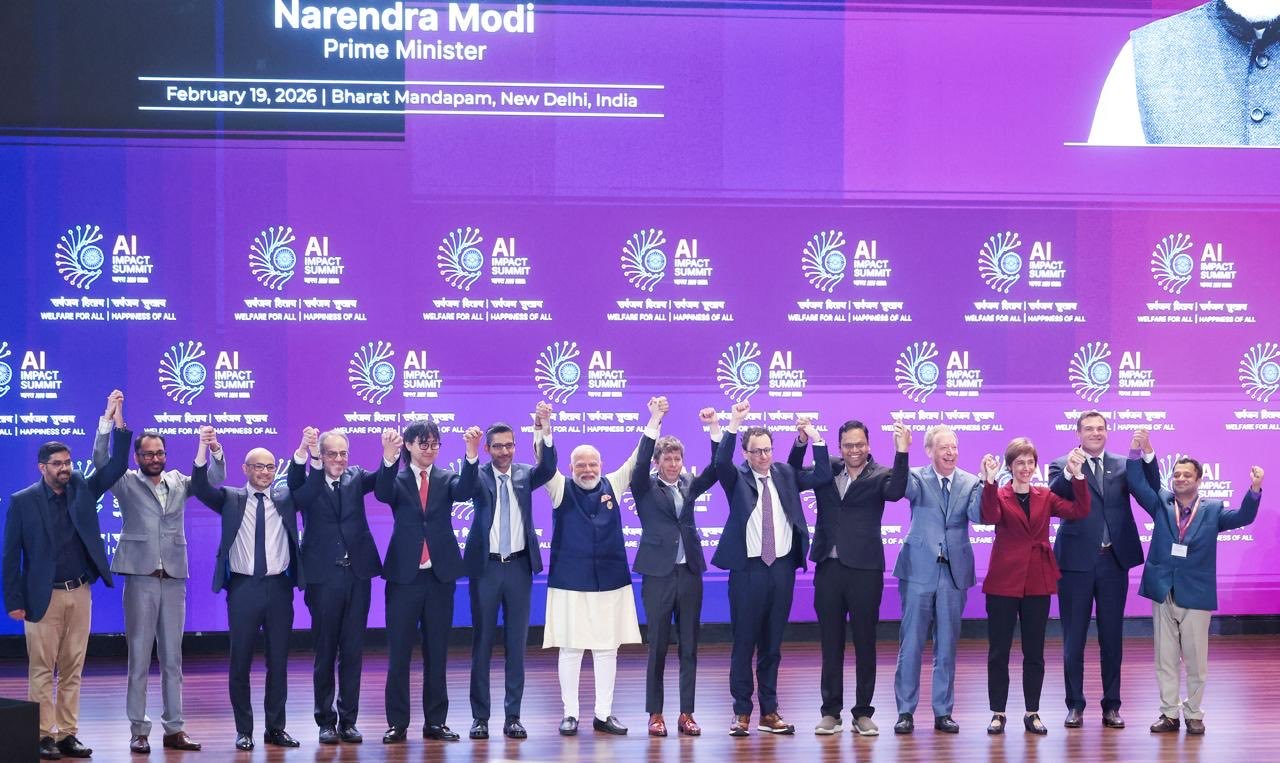
The Hand-Holding Incident (Because I Have to Mention It)
At the Leaders’ Plenary, PM Modi gathered all the tech CEOs on stage for a photo. In a moment of diplomatic unity, he encouraged everyone to hold hands for the shot.
Sam Altman and Dario Amodei, whose companies are probably the two most intense competitors in AI right now, visibly declined to hold each other’s hands. Altman later said he was just “confused about what was happening.”
Sure, Sam.
It was a small, slightly awkward moment that the internet turned into a meme. But in a weird way, it summed up the entire summit: everyone shows up, everyone commits to cooperation, and then when it comes to actually joining hands with the competition, the arms stay firmly at the sides.
So, Was It Worth It?
The Delhi Declaration got signed. $200+ billion in commitments was announced. India’s homegrown AI ecosystem got a global stage. The conversation shifted from “AI as a Western race” to “AI as a global opportunity.” Anthropic opened a Bengaluru office. The government tripled its GPU target.
Was it chaotic? Absolutely.
Was it over-hyped in some places? Definitely.
Did it matter? Yeah. I think it did.
India has about 10% of the world’s developer population. It has the second-largest English-speaking tech workforce on the planet. It has 22 languages that most AI models barely understand. And it just told the world, loudly, publicly, with Mukesh Ambani, Sam Altman, and the President of France in the same room, that it intends to shape what comes next.
What happens in the next few years will tell us whether this was a turning point or just a very expensive conference.
As engineers, we don’t get to just watch. We’re the ones who build it.
India AI Summit 2026, India AI Impact Summit, AI in India, New Delhi AI Declaration, Sarvam AI, BharatGen, IndiaAI Mission, OpenAI India, Anthropic India, AI investment India, future of AI, engineers and AI