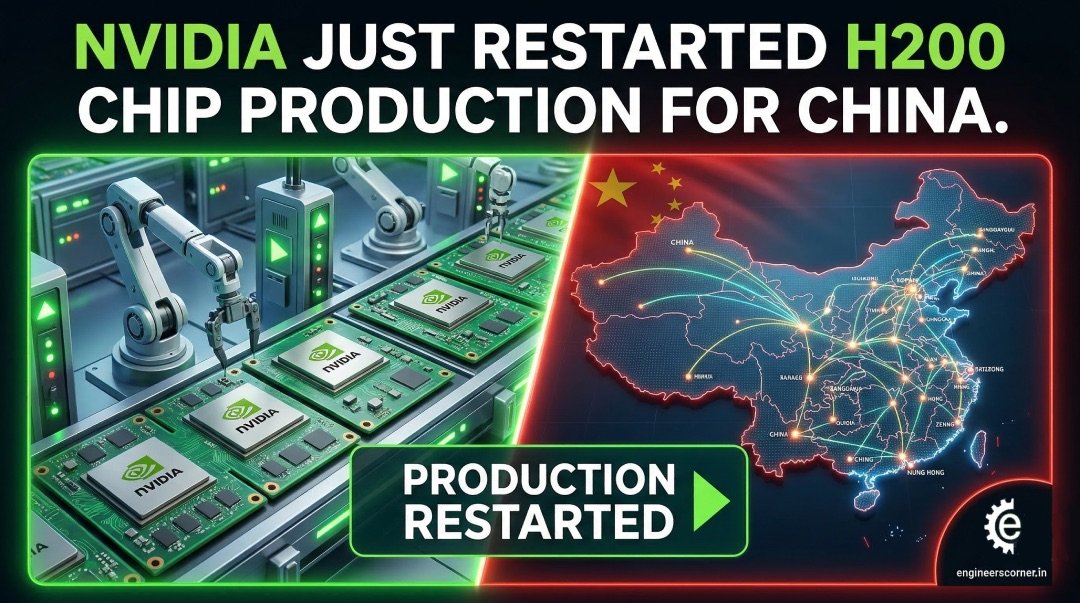
When Jensen Huang stepped in front of reporters at GTC on March 17 and casually said “that’s new news for all of you,” he was not exaggerating. Just weeks after Nvidia’s own CFO told Wall Street analysts the company had zero China data center revenue baked into its quarterly forecast, the CEO was announcing that purchase orders from Chinese customers are in hand and manufacturing is back on.
“We’ve been licensed for many customers in China for H200,” Huang told reporters in San Jose. “We have received purchase orders from many customers, and we’re in the process of restarting our manufacturing. Our supply chain is getting fired up.”
That is a pretty big deal. This story has been reversing on itself every few months, and if you have been trying to keep up with it, you are probably exhausted. So here is the full picture, from how we got here to what it actually means right now.
The reason this restart took so long is that it needed two governments to say yes, not one. Washington had to approve the export license, and Beijing had to approve the import. For the past year, neither side was moving fast enough for the other.
The US first started restricting AI chip exports to China in October 2022 under the Biden administration, blocking chips like the A100. Nvidia responded by engineering downgraded versions- the A800, H800, and eventually the H20 that technically stayed within allowed performance limits. Chinese companies bought them in huge quantities because they were still better than anything available domestically.
Then in April 2025, the Trump administration tightened things further and required export licenses even for the H20. That effectively shut Nvidia out of China entirely. At its peak, China made up somewhere between 13 and 25 percent of Nvidia’s total revenue. After the restrictions kicked in, Nvidia stopped counting China in its financial guidance at all. If you looked at the company’s earnings calls from the past year, China was essentially treated as a closed market.
Trump reversed that in December 2025, giving Nvidia the green light to sell its H200 chips to vetted Chinese customers. But here is where the second wall appeared. Even after the US approved exports, Beijing was reportedly discouraging domestic companies from actually buying. Chinese authorities were pushing Huawei’s Ascend chips as the preferred alternative, and companies that tried to import the H200 were apparently told they needed to meet “special circumstances” criteria first.
By February 2026, Nvidia’s CFO Colette Kress was still telling analysts that only a “small number of H200 products” had been US-approved, and that the company had “yet to generate any revenue” from them. The Financial Times reported that Nvidia had quietly paused H200 production for China entirely, having already wound down its older Hopper-class manufacturing line to focus on the newer Blackwell chips.
And then, just three weeks later, Huang is at GTC saying the supply chain is getting fired up. Something clearly changed between early March and March 17 and according to Reuters, what changed is that Beijing finally gave its approval for H200 imports.
If you are not deep into the chip world, the naming gets confusing fast, so a quick explainer is worth it here.
Nvidia’s AI accelerator lineup right now goes roughly: H20 (downgraded, China-safe) at the bottom, H200 (the middle tier that China is now getting), and Blackwell chips like the B200 and GB200 at the top. The Blackwell series is still completely off-limits for China. The H200 uses Nvidia’s older Hopper architecture and packs 141GB of HBM3e memory. It is roughly six times more powerful than the H20 that China was previously limited to.
For companies like Alibaba, ByteDance, and Tencent, which run AI workloads at an absolutely enormous scale, the difference between an H20 and an H200 is not trivial. Training large language models, running real-time recommendation engines, powering inference for hundreds of millions of users- all of it gets meaningfully faster and cheaper with the H200. The Chinese hyperscalers have been waiting for this chip for a long time.
Before anyone assumes China can now freely buy Nvidia chips, it cannot. The licensing framework the US Commerce Department published in January 2026 comes with several layers of restrictions.
Chinese buyers need individual approval from Washington before purchasing anything. Only a specific list of companies has received clearance, ByteDance, Alibaba, and Tencent are among the confirmed names, but the total pool is limited. On top of that, the H200 approval only covers up to 50 percent of the volume Nvidia sells domestically in the United States. So China cannot simply buy unlimited quantities, even with the license in hand.
Every single shipment has to be verified by an independent third-party laboratory before it can be re-exported into China. That adds logistical complexity and time to every transaction. Nvidia also reportedly agreed as part of the deal to send 25 percent of its China chip sales revenue back to the US government. That is an unusual arrangement and probably one of the odder parts of this entire saga. And the Blackwell chips, Nvidia’s latest and most powerful generation, remain completely blocked. China is getting a chip that is already one generation behind Nvidia’s current flagship.
Huang himself acknowledged during the GTC media session that President Trump’s position is that the US should maintain a technology leadership position globally while still competing for international markets. “He would like us to compete worldwide and not concede those markets unnecessarily,” Huang said. That reads like a diplomatic way of saying: we can sell chips, but only the older ones.
A separate detail from Reuters adds another layer to this. Nvidia is reportedly developing a version of its Groq AI chip that can legally be sold in China. While Nvidia’s Blackwell and Vera Rubin chips are aimed at AI training (teaching models from scratch), the Groq chip is targeted at inference- meaning running and answering queries from AI models that already exist.
The inference market is growing extremely fast as AI gets deployed in actual products and services. Nvidia faces more competition there than in training, but it is also a massive opportunity. Having a China-legal inference chip sitting alongside the H200 for training tasks would give Nvidia a more complete product lineup for the Chinese market within what US regulations allow.
This is probably the most important context that gets skipped in a lot of chip war coverage. While all of this licensing drama was playing out, China was building its own AI chip ecosystem in parallel, and it has made real progress.
Huawei’s Ascend 910B is already being deployed for AI training by Chinese companies. The chip has real limitations compared to the H200, particularly around the high-bandwidth memory that makes Nvidia’s chips so powerful for large model training. But Huawei is iterating fast. The company claims to have developed its own HBM-equivalent memory chips internally, which if true, would close one of the main performance gaps between Chinese chips and what Nvidia offers.
China’s SMIC is also pushing toward more advanced manufacturing processes, and Beijing has invested enormous amounts of state money into building out a domestic semiconductor supply chain from design to production. The long-term goal is clear: China wants to reach a point where it does not need permission from Washington to access the hardware its AI industry requires.
This is why the chip export saga matters beyond Nvidia’s revenue numbers. Every month of restricted access pushes China harder toward that goal. Ironically, the partial re-opening might actually slow that push, since Chinese companies now have a somewhat easier path to the chips they need today.
One thing that rarely gets enough attention in mainstream coverage: throughout the entire period when Nvidia chips were banned, a significant underground market for those same chips was running in parallel. US authorities have uncovered multiple operations where restricted GPUs were rerouted through Singapore, Malaysia, Indonesia, and other countries using falsified shipping documents and shell companies.
A case that became public in late 2025 involved four Americans charged with routing an estimated $160 million worth of restricted H100 and H200 chips to China through mislabeled shipments. Two others were charged in a separate case involving 21 illegal export shipments run through a California company. And DeepSeek, the Chinese AI startup that made waves internationally for its efficiency claims, was accused of using smuggled Blackwell chips in its development process, though Nvidia said it had no evidence of that.
The point of mentioning this is straightforward: if chips were getting into China anyway through illegal channels, having a legal, controlled sales route at least gives the US government visibility into what is being sold and to whom. Whether that trade-off makes sense from a national security standpoint is genuinely debated. But it is part of why the Trump administration eventually landed on a licensed-sales approach rather than a total ban.
A few things will determine whether this restart actually delivers for Nvidia or runs into another wall. The first is how quickly manufacturing actually scales. Nvidia already wound down its Hopper-class production lines to shift focus to Blackwell. Restarting those lines takes real time, and Huang acknowledged the supply chain is just getting started. Getting from “fired up” to actual chip deliveries in China could take several months.
The second is whether Chinese companies actually place large orders. Beijing’s stance has been inconsistent, pushing domestic alternatives one week, approving imports the next. If the Chinese government quietly discourages or delays actual purchases at the company level, Nvidia could have all the licenses it needs and still not ship much. This has been the pattern for the past few months.
The third thing to watch is Huawei. Every quarter of Huawei Ascend development narrows the gap between China’s domestic chips and what Nvidia is offering. The H200 is a generation-old chip. If Huawei’s next Ascend iteration closes that performance gap significantly, Chinese companies may have less reason to go through the complicated US licensing process anyway.
And finally, the political situation can still flip. This story has reversed course enough times that assuming the current state is permanent would be a mistake. If US-China relations deteriorate sharply, or if there is a shift in how Congress views chip exports, the licensing framework could tighten again relatively quickly.
Jensen Huang spent most of the past year telling anyone who would listen that restricting chip exports to China was bad policy that would hurt American companies without actually stopping Chinese AI development. Whether you agree with him or not, the situation at GTC confirms one thing: the total ban approach did not hold. Washington is now trying a middle-ground strategy, sell the older chips, hold back the newest ones, collect a cut of the revenue, and keep close tabs on every shipment.
Whether that middle ground actually works for anyone, US national security, Nvidia’s business, or China’s AI ambitions, is a question that will play out over the next couple of years, not the next couple of weeks. But at minimum, for the first time since April 2025, Nvidia and China are doing business again. That alone is a significant shift in a story everyone in the tech industry has been watching closely.
The H200 is Nvidia’s Hopper-generation AI accelerator, featuring 141GB of HBM3e memory. It is considerably more powerful than the H20 chip that China was previously limited to, but it sits a full generation below Nvidia’s current Blackwell lineup. Think of it as a high-end chip from last year’s product cycle, still very capable for AI training and inference, but not Nvidia’s newest.
Yes, both the US and Chinese governments have now given their approval. The US Commerce Department published the licensing framework in January 2026, and Beijing reportedly gave its approval on the same day as Jensen Huang’s announcement at GTC. That double approval was the final piece that had been missing.
Because the export license from Washington only solves half the problem. China also needed to approve the imports on its end, and Beijing was reportedly holding back, pushing domestic companies toward Huawei’s Ascend chips instead. That standoff lasted roughly three months before both sides aligned.
No. Buyers need individual vetting and approval from the US government. The licensing framework also caps total volume at 50 percent of Nvidia’s domestic US sales, requires third-party lab verification of each shipment, and reserves Nvidia’s newest Blackwell chips for non-China markets only.
No. Blackwell-series chips and the upcoming Vera Rubin architecture remain completely off-limits under current export controls. The H200 is the most advanced chip China can currently receive from Nvidia.
That is one of the more unusual conditions of the licensing deal. The US government essentially attached a revenue-sharing requirement as part of granting Nvidia permission to re-enter the Chinese market. It is framed as a way for the US to benefit financially from the sales while maintaining oversight over the trade.
On March 27, 2026, breaking news from Washington confirmed what the cybersecurity world had been…
Indian Railways has announced one of the biggest government job opportunities of 2026. The Railway…
The National Testing Agency (NTA) is all set to release the JEE Main 2026 Session 2…
AKTU Result 2026 for odd semester UG and PG examinations has been officially declared. Dr.…
RMLAU Result 2026 for odd semester UG and PG examinations is expected to be declared…
The Bihar School Examination Board (BSEB) has officially declared the Bihar Board 12th Result 2026.…