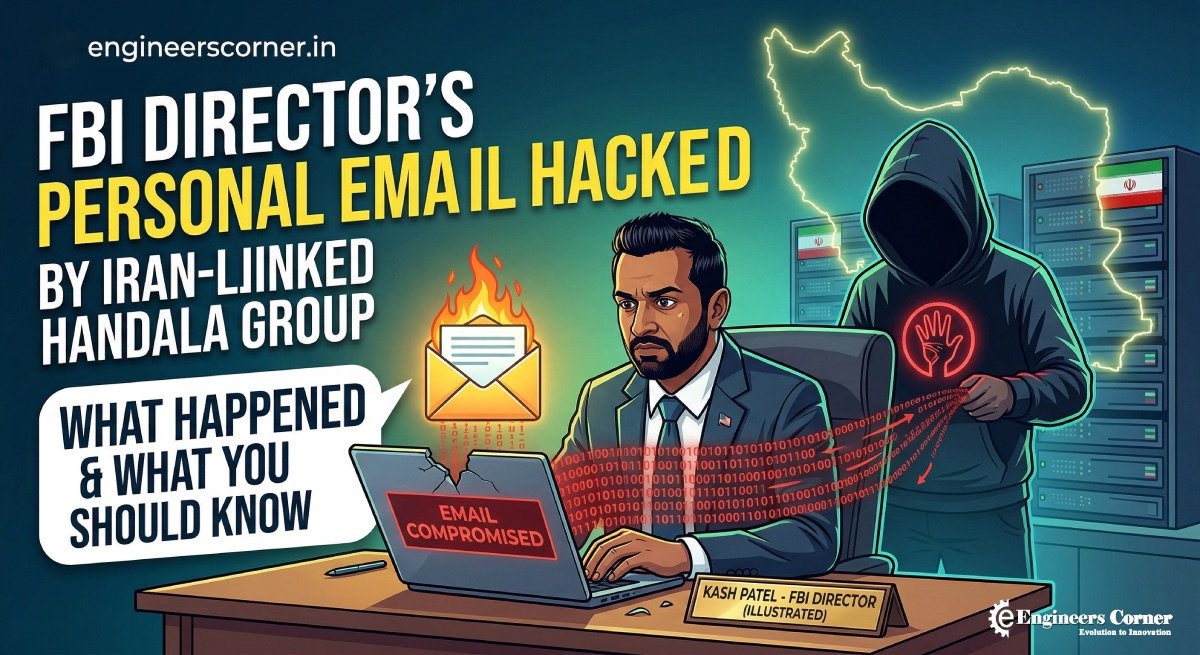
On March 27, 2026, breaking news from Washington confirmed what the cybersecurity world had been watching unfold in real time: the personal email account of FBI Director Kash Patel had been hacked. The group behind the breach, called Handala Hack Team, published photographs, what appeared to be Patel’s resume, and a mix of personal correspondence online. The US Department of Justice confirmed that the breach was real and that the published material appeared authentic.
This article breaks down everything you need to know about the hack, who Handala really is, and most importantly, what this entire episode teaches us about protecting our own email accounts.
On March 27, 2026, the Iran-linked hacker group Handala Hack Team posted on their website that FBI Director Kash Patel would “now find his name among the list of successfully hacked victims.” Along with that announcement, they published photographs of Patel and documents they claimed to have taken from his personal Gmail inbox.
A Justice Department official confirmed to Reuters that Patel’s personal email account had indeed been compromised. The FBI did not immediately comment. Reuters noted that the Gmail address Handala claimed to have accessed matched an address linked to Patel in older data breaches, according to the dark web intelligence firm District 4 Labs.
The leaked material reportedly contains a mix of personal and work correspondence from roughly 2010 to 2019. Cybersecurity researcher Ron Fabela noted that the breach appeared to target a personal account rather than any government system, and that the actual leaked content included things like old personal emails and family photos rather than sensitive classified material. In other words, Handala broke into Patel’s Gmail, not the FBI’s servers.
Key facts confirmed:
To understand this hack, you need to understand the broader context of what has been happening between the United States, Iran, and Israel in early 2026.
On February 28, 2026, the US and Israel launched military strikes on Iranian targets (referred to as Operation Epic Fury). In the weeks that followed, Handala significantly escalated its cyber operations against American and Israeli targets.
On March 11, 2026, Handala claimed responsibility for a destructive malware attack on Stryker Corporation, a Michigan-based medical device company. Cybersecurity investigators later found that the attackers had been inside Stryker’s network for months and ultimately used Microsoft Intune, Stryker’s own endpoint management platform, to wipe over 200,000 devices across 79 countries. It is described as one of the most operationally destructive cyberattacks ever executed against a US company.
On March 19, 2026, the US Department of Justice announced the seizure of four domains used by Handala, including handala-hack.to and handala-redwanted.to, as part of efforts to disrupt Iranian cyber-enabled psychological operations. The DOJ also announced a $10 million reward for information about the group. currently these website shows as ‘This website has been seized by FBI’
In a remarkable sequence of events, Handala registered a new domain that very same day and used it to launch the attack on Patel’s account, essentially responding to the US seizure and reward announcement by hacking the FBI Director’s personal email within hours.
Handala positions itself publicly as a pro-Palestinian vigilante hacking group, borrowing its name and logo from a famous Palestinian political cartoon created by artist Naji al-Ali. But Western cybersecurity researchers are in near-unanimous agreement that the reality is quite different.
The official cybersecurity verdict:
Handala Hack Team is widely assessed to be an online persona operated by Void Manticore, a cyber unit inside Iran’s Ministry of Intelligence and Security (MOIS). It is tracked under several names in the threat intelligence community, including Storm-0842, Banished Kitten, and COBALT MYSTIQUE. Check Point Research has documented overlapping code between Handala and other MOIS-linked personas including Karma and Homeland Justice.
The group operates with an estimated annual budget of approximately $7.7 million. It first emerged in December 2023, shortly after the October 7, 2023 Hamas attacks on Israel. Between February 2024 and February 2025 alone, researchers at Reichman University documented at least 85 claimed attacks, primarily against Israeli targets across healthcare, information technology, education, government, and defense sectors.
Handala’s known tactics:
The leadership connection:
The group’s operations were overseen by Seyed Yahya Hosseini Panjaki, a deputy minister-level official within MOIS who was sanctioned by the US Treasury in September 2024 and later by the EU and UK, and placed on the FBI terrorism watchlist. He was reportedly killed in Israeli strikes on Iranian intelligence targets in early March 2026.
Handala has a documented history of significant attacks before this Kash Patel incident:
Stryker Corporation (March 11, 2026): Claimed to have deleted a massive trove of data using the company’s own Microsoft Intune management platform to wipe devices across 79 countries. Considered one of the most destructive attacks on a US company in recent years.
Soreq Nuclear Research Center (September 2024): Claimed to have extracted approximately 197 GB of classified nuclear project data from an Israeli research facility. Israel’s National Cyber Directorate assessed this primarily as psychological warfare.
Israeli Police (February 2025): Claimed exfiltration of 2.1 TB of data including personnel records and psychological profiles of officers.
Israeli Kindergartens (January 2026): Compromised emergency alert systems at over 20 kindergartens and activated air raid sirens while broadcasting threatening Arabic messages to children.
Lockheed Martin (2026): Made claims of breaching the US defense contractor, though Lockheed denied any confirmed breach.
Geographically, Israel remains Handala’s primary focus. However, since the February 2026 US-Israeli strikes on Iran, American organizations have faced increasing exposure.
There are a few reasons this particular target makes sense from Handala’s strategic perspective.
First, Kash Patel is the Director of the FBI, the very agency that has been investigating and disrupting Iranian cyber operations. Breaching his personal account, even if it contains no classified data, sends a powerful symbolic message.
Second, Patel had already been identified as a target of Iranian hacking efforts back in late 2024, when a broader Iranian campaign targeted incoming Trump administration officials including now-Deputy AG Todd Blanche and Donald Trump Jr. The attack on his Gmail was not spontaneous.
Third, Handala’s operations are primarily psychological in nature. The goal is not necessarily to extract valuable intelligence but to humiliate, create headlines, and project the capability to reach high-value targets. Publishing the FBI Director’s old emails and photographs achieves exactly that objective, regardless of the actual sensitivity of the content.
While this incident involves the FBI Director, the actual vulnerability exploited was a personal Gmail account. That is something any of us could be using. Here is what this case teaches us:
1. Personal accounts are often the weak link
Government officials, corporate executives, and even ordinary professionals maintain personal email accounts that often have weaker security than their official accounts. Attackers know this and deliberately target personal accounts to bypass institutional security measures.
2. Old data breaches do not just disappear
The Gmail address used by Patel had already appeared in older data breach records. When your email or password shows up in a breach, attackers store that data and use it later. Always check if your accounts have appeared in known breaches using tools like Have I Been Pwned (haveibeenpwned.com).
3. Two-Factor Authentication (2FA) is not optional for important accounts
If 2FA had been properly enabled on the account, credential theft alone would not have been enough to gain access. For anyone with any public-facing role or sensitive information, 2FA should be treated as mandatory, not optional.
4. “Personal” does not mean “unimportant” from a security standpoint
Even your personal email likely contains years of correspondence, financial information, travel history, and personal contacts. For a senior official, that is a goldmine for intelligence purposes even without a single classified document.
5. Nation-state hackers are patient
Handala did not just stumble onto Patel’s account. Evidence suggests they had identified him as a target in 2024 and acted when the timing was geopolitically convenient in 2026. Nation-state actors plan these operations over months or years.
Handala has primarily focused on Israeli and American targets. However, the group’s targeting does follow geopolitical logic. Any country or organization that is seen as aligned with the US-Israel position in the current conflict could become a secondary target.
India maintains relationships with both Israel and Iran, and Indian IT infrastructure, healthcare organizations, and financial institutions should treat this as a reminder to audit their own security posture, particularly around VPN access, email security, and endpoint management platforms.
Q: Who hacked Kash Patel’s email? A: An Iran-linked hacker group called Handala Hack Team claimed responsibility. The US Department of Justice confirmed the breach was real and the leaked material appeared authentic.
Q: Was classified FBI data leaked? A: No. The hack targeted Patel’s personal Gmail account, not any FBI or government system. The leaked content was primarily personal in nature, including old photographs and correspondence.
Q: What is Handala Hack Team? A: Handala presents itself as a pro-Palestinian vigilante hacking group, but Western cybersecurity researchers identify it as a cyber persona operated by Iran’s Ministry of Intelligence and Security. It is one of the most active and destructive Iranian cyber actors currently operating.
Q: How do I protect my own email from similar attacks? A: Enable Two-Factor Authentication, use a strong unique password, check if your email has appeared in past data breaches at haveibeenpwned.com, and be careful about clicking links in unsolicited emails.
Q: What is Void Manticore? A: Void Manticore is the technical name used by cybersecurity researchers (particularly Check Point Research) to refer to the Iranian MOIS cyber unit that operates the Handala persona. It is also tracked as Storm-0842, Banished Kitten, and COBALT MYSTIQUE.
This article is based on reports from Reuters, Newsweek, the US Department of Justice, Check Point Research, Palo Alto Networks Unit42, and SOCRadar. It covers a breaking news story and will be updated as more details emerge.
Indian Railways has announced one of the biggest government job opportunities of 2026. The Railway…
The National Testing Agency (NTA) is all set to release the JEE Main 2026 Session 2…
AKTU Result 2026 for odd semester UG and PG examinations has been officially declared. Dr.…
RMLAU Result 2026 for odd semester UG and PG examinations is expected to be declared…
The Bihar School Examination Board (BSEB) has officially declared the Bihar Board 12th Result 2026.…
If you watched Dhurandhar Part 2: The Revenge this week and came home Googling "how to join…