
Dell Technologies released its annual report on Monday and buried inside the filing was a number that deserves more attention than it got. The company cut approximately 11,000 employees during fiscal year 2026, bringing its total headcount down to around 97,000. That is the third straight year Dell has shed roughly 10% of its workforce. Since 2023, Dell has lost 36,000 employees, over a quarter of its total headcount.
The same annual report also disclosed that Dell generated a record $113.5 billion in revenue last year. Its AI-optimized server business grew 342% year over year. The company is sitting on a $43 billion AI server backlog heading into fiscal 2027. Dell’s stock is up 24% this year.
Read that twice. Record revenue. 342% AI growth. $43 billion backlog. 11,000 people gone anyway.
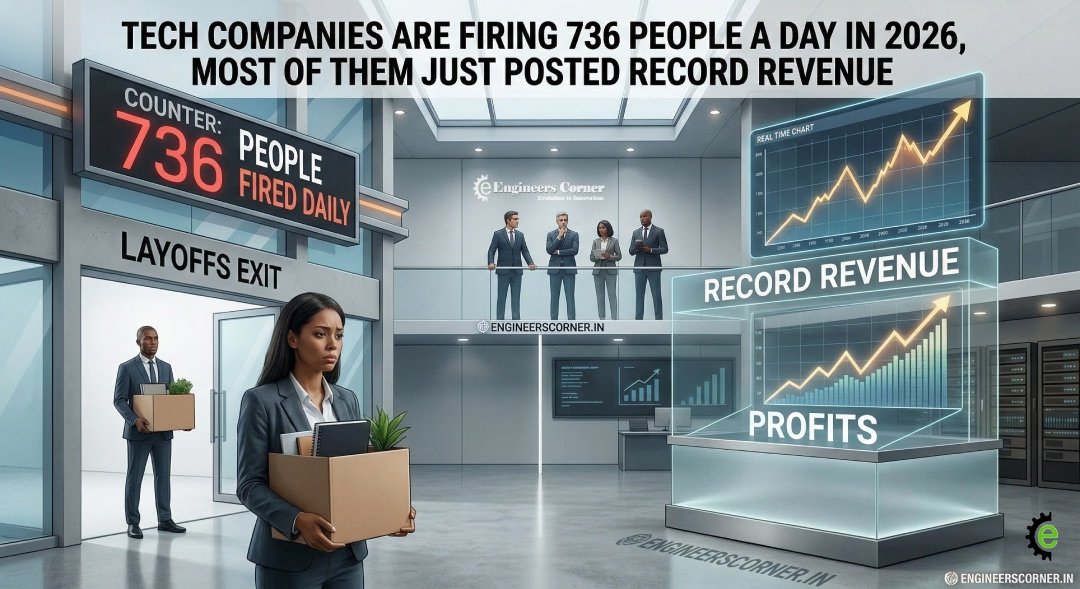
Dell is not alone. Right now, in the first 74 days of 2026, the tech industry has cut 55,911 jobs across 171 companies, according to layoff tracking site TrueUp. That works out to 736 people per day, every day, since January 1. And the companies doing the most cutting are not struggling startups burning through runway. They are Amazon, Meta, Oracle, Block, and Atlassian, some of the most profitable technology companies on the planet.
The Numbers That Do Not Add Up at First Glance:-
Amazon is the single largest contributor to 2026 tech layoffs, having announced 16,000 job cuts in January alone, on top of the 14,000 it cut in October 2025. That is 30,000 people in roughly six months. Amazon’s full-year revenue for 2025 was $716.9 billion, a record. The company justified the cuts by citing a need to “flatten reporting structures” and “speed up decision-making.” Wall Street rewarded it with a higher stock price.
Block, the payments company founded by Jack Dorsey, cut 4,000 employees in January, representing 40% of its entire workforce. Block’s Q4 gross profit came in at $2.87 billion, up 26% year over year. In his memo to employees, Dorsey was unusually blunt: “AI tools can perform a wider range of tasks.” Block now operates at roughly the same revenue it generated when it had 10,000 people, but with 6,000. That is a productivity story Wall Street finds very attractive.
Atlassian, the Australian enterprise software giant behind Jira and Confluence, cut 1,600 employees in March, 10% of its global workforce. CEO Mike Cannon-Brookes wrote something in his note to staff that has since been quoted in almost every tech industry analysis published this month: “It would be disingenuous to pretend AI doesn’t change the mix of skills we need or the number of roles required in certain areas. It does.” The company simultaneously announced plans to hire approximately 800 new AI-focused roles. A net reduction of 800, but a completely different kind of company coming out the other side.
Meta has cut 1,500 employees from its Reality Labs division in 2026 so far, with Reuters reporting the company may announce reductions of up to 16,000 additional employees across its broader workforce. Meta is also doubling its AI research and development budget to $135 billion in 2026. An internal memo that leaked earlier this year put the company’s reasoning in stark terms: “Projects that used to require big teams can now be accomplished by a single very talented person.”
Dell Is the Most Revealing Case of All:-
Of all the companies cutting jobs in 2026, Dell’s situation is the most instructive because it strips away the ambiguity. Amazon and Meta can at least point to prior overexpansion during the pandemic era as partial explanation for their reductions. Dell never had a pandemic hiring spike. Its cuts have been steady, consistent, and deliberate across three consecutive years.
What Dell is doing is a slow, systematic trade. It is shrinking the workforce that sells and supports traditional PCs, enterprise laptops, and conventional storage systems, while growing the team that sells AI-optimized servers and infrastructure to the hyperscalers building out AI data centers. The two businesses require completely different people. The first business, which made Dell famous, is shrinking. The second business grew 342% last year and is the reason Dell’s stock is at a multi-year high.
The 11,000 people who left Dell in fiscal 2026 were not fired because the company was struggling. They were let go because the specific work they did is either automatable, declining in demand, or being replaced by a much smaller team using AI tools to cover the same ground. Dell paid $569 million in severance during fiscal 2026, a real cost that shows up on the income statement. But the math still worked in the company’s favor. That is why three years of 10% annual cuts and the stock keeps going up.
Is AI Actually to Blame, or Is This Something Else?
Most coverage of this story treats AI as the villain and moves on. The actual data does not support that clean a narrative. Research firm RationalFX analyzed every confirmed tech layoff in 2026 through early March and found that only about 9,238 of them, roughly 20% of the total, were directly linked to AI adoption or automation. That means 80% of the jobs being cut in 2026 have nothing to do with AI at all. They are driven by post-pandemic overcorrection, debt servicing, management layer elimination, and the kind of financial engineering that has always existed in large companies but gets a convenient new label when AI is in the news.
Sam Altman, CEO of OpenAI, actually used the phrase “AI washing” in a public comment earlier this year, referring to companies that blame AI for layoffs that would have happened regardless of whether a single AI tool had ever been deployed. It is a striking thing for the person running the most influential AI company in the world to say. He is essentially acknowledging that AI has become a PR cover for decisions driven by shareholder pressure, not technology capability.
But here is the problem with leaning too hard on that cynical read: the 20% that are genuinely AI-driven are real, accelerating, and concentrated in specific roles that happen to employ a lot of people. Quality assurance and testing, tier-1 customer support, content creation, mid-level project management, and basic data operations are all seeing reductions that companies are explicitly, publicly tying to AI tooling. Atlassian said its AI tools reduced the need for manual testing by approximately 60%. Block’s entire restructuring thesis is built on AI enabling a much smaller team to handle the same workload. Companies have already made this bet with real money, real severance cheques, and real people’s jobs. The debate about whether AI replaces workers is largely settled at the corporate decision-making level. The question now is how fast and how many.
The Jobs That Are Disappearing Fastest
Data from the 171 layoff events tracked so far in 2026 shows a pattern in which roles are being cut most aggressively. Middle management is at the top of the list. Amazon’s cuts specifically targeted program managers and team leads. The manager-to-individual-contributor ratio has shifted from roughly 1:6 to 1:10 or higher at multiple large companies. When an AI tool can generate status reports, synthesize meeting notes, and flag project risks automatically, the coordination layer of a company becomes much thinner.
QA and manual testing roles are disappearing quickly at software companies. AI-generated test suites now handle regression testing and bug identification at a level of coverage that previously required dedicated teams. Content and marketing generalist roles are also declining as AI writing tools mature. And tier-1 customer support, the large teams that handle simple inbound queries, is being replaced by AI agents at companies including eBay, ANGI, and Meta, reducing human support to escalation specialists rather than front-line responders.
The hiring side is narrow and specific. AI engineers, machine learning operations specialists, prompt engineers, AI safety researchers, and data architects are all in demand. Companies like Atlassian are bringing on 800 new AI-focused roles while eliminating 1,600 generalist ones. The net employment number goes down, but the skill profile of the surviving workforce shifts sharply. The people building and maintaining AI systems are staying. The people doing work those systems can now handle are not.
What This Pace Actually Means by December
At the current rate of 736 layoffs per day, total tech job cuts in 2026 will exceed 264,000 by December 31. For context, 2025’s total was 245,000, which at the time was described as a significant year for tech unemployment. The 2023 total, which everyone in the industry remembers as the year of the great post-pandemic correction, was around 191,000 for US-based companies alone.
If the 264,000 projection holds, 2026 will be the worst year for tech employment since the dot-com bust in 2001 and 2002. And this time, unlike 2001, the companies doing the cutting are not going bankrupt. They are reporting record revenues, buying back stock, and investing more in capital expenditure than at any point in their history. Oracle is reportedly planning cuts affecting tens of thousands of employees while simultaneously raising $50 billion for AI data center infrastructure. The money is not leaving tech. It is just moving from payroll to compute.
The Question Nobody in a Corner Office Wants to Answer
Every large tech company has a version of the same prepared answer when journalists ask about AI and layoffs. AI creates new jobs even as it displaces old ones, the net effect will be positive over time, and workers who develop AI skills will be fine. This is probably true in some long-run equilibrium that economists can model in a spreadsheet. It is cold comfort to the 11,000 people who left Dell this year, or the 16,000 who got the Amazon call in January.
The honest version of what is happening in 2026 is that large tech companies figured out how to use AI tools to get the same or better business results with significantly fewer people, and they are acting on that discovery as fast as their severance budgets and legal departments allow. The revenue is not just holding up under smaller headcounts. In most cases it is growing faster than before. Block’s gross profit grew 26% in the same quarter it cut 40% of its workforce. That combination, higher revenue, lower costs, smaller teams, is exactly what Wall Street has wanted from these companies for years. AI just made it achievable.
MIT and Oxford researchers found that 95% of companies investing in AI are getting no measurable return yet. That means most of the current disruption is front-running actual productivity gains. The cuts are happening based on what CEOs believe AI will be capable of in 18 months, not what it demonstrably delivers today. That gap between belief and reality is cold comfort if you are one of the 55,000 people who received a layoff notice in the first 74 days of this year.
Go back and look at Dell’s last three annual reports side by side. The headcount drops are almost mechanical: 10%, 10%, 10%. No panic, no emergency restructuring memo, no dramatic all-hands. Just a quiet, consistent reduction that the market has rewarded every single year. That pattern is the most honest picture of where this industry is heading. Cutting thousands of jobs while posting record revenue is no longer something large tech companies feel they need to justify. It has become the standard playbook.
Frequently Asked Questions:-
How many tech jobs have been cut in 2026 so far?
As of mid-March 2026, over 55,900 tech jobs have been cut across 171 companies, averaging 736 layoffs per day. The largest single event was Amazon’s announcement of 16,000 job cuts in January. Dell, Block, Atlassian, Meta, and Oracle have all confirmed significant workforce reductions in the same period.
Why is Dell laying off employees despite record revenue?
Dell reported a record $113.5 billion in revenue for fiscal 2026 while also confirming around 11,000 job cuts during the same year. The company is redirecting budget from traditional PC and enterprise hardware roles toward AI infrastructure, where its server business grew 342% year over year. The layoffs reflect a structural shift in which skills Dell needs going forward, not a company in financial trouble.
Is AI actually the real reason for tech layoffs in 2026?
Only about 20% of 2026 tech layoffs are directly attributed to AI adoption, according to RationalFX research. The remaining 80% stem from post-pandemic overcorrection, debt servicing, and management restructuring. However, AI is increasingly being used as justification for cuts that might have happened anyway, a pattern OpenAI CEO Sam Altman has publicly called AI washing.
Which tech companies have cut the most jobs in 2026?
Amazon leads with 16,000 confirmed cuts and reportedly another 14,000 planned for Q2. Dell confirmed around 11,000 cuts in its fiscal 2026 annual report. Block cut 4,000 employees, representing 40% of its workforce. Atlassian cut 1,600 in March. Meta has cut 1,500 from Reality Labs with reports of up to 16,000 further reductions being planned company wide.
Will tech layoffs continue through the rest of 2026?
Based on the current daily pace, total 2026 tech job cuts could exceed 264,000 by December, which would surpass 2025’s total of 245,000 and make this the worst year for tech employment since the dot-com bust. Oracle is reportedly planning large-scale reductions while expanding AI infrastructure spending. The structural shift toward smaller, AI-assisted teams is still early, meaning more cuts are likely before hiring patterns stabilize.