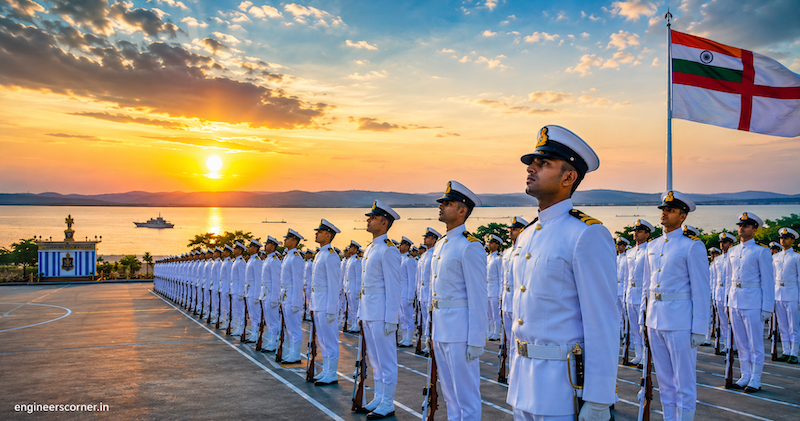
If you hold an engineering diploma and have ever considered serving the nation in uniform, this is your moment. The Indian Navy has officially opened applications for the Agniveer (Apprentice) 01/2027 and 02/2027 batches under the Agnipath Scheme. The notification was released on June 2, 2026, and the application window is live at joinindiannavy.gov.in.
This is one of the very few central government defence recruitment drives designed specifically for diploma-qualified technical candidates, covering engineering and electrical streams. If you are an unmarried male candidate with a 3-year AICTE-recognised polytechnic diploma and at least 50 percent marks in both Matriculation and your diploma programme, read this article carefully before the window closes on June 29, 2026 at 17:00 hrs.
| Detail | Information |
|---|---|
| Recruiting Body | Directorate of Manpower Planning and Recruitment, Naval HQ, New Delhi |
| Post Name | Agniveer (Apprentice) |
| Batches | 01/2027 and 02/2027 |
| Exam | INET 2/2026 |
| Application Start | June 5, 2026 (10:00 hrs) |
| Application Last Date | June 29, 2026 (17:00 hrs) |
| Correction Window | July 6, 2026 |
| Stage I Exam Date | Tentatively August 2026 |
| Exam Partner | Staff Selection Commission (SSC) |
| Training Location | INS Chilka, Odisha |
| Official Website | joinindiannavy.gov.in |
The Agniveer (Apprentice) entry is part of the Government of India’s Agnipath Scheme, which brings in technically skilled young individuals into the armed forces for a fixed four-year engagement under the Navy Act, 1957. Agniveers form a distinct rank, different from any other existing rank, and are the junior-most rank in the Indian Navy. The Navy is not obligated to retain Agniveers beyond the four-year engagement period.
The entry is distinctly technical. Candidates are recruited into Engineering and Electrical branches, trained at INS Chilka in Odisha, and then serve in hands-on technical roles aboard ships and shore establishments. For diploma holders seeking structured national service with a real salary and a transferable skills certificate, this entry offers a meaningful four-year commitment.
| Recruitment Activity | Tentative Timeline |
|---|---|
| Application window opens | June 5, 2026 (10:00 hrs) |
| Application window closes | June 29, 2026 (17:00 hrs) |
| Correction window | July 6, 2026 |
| Stage I INET 2/2026 | August 2026 |
| Stage I Result Declaration | End of August / Early September 2026 |
| Shortlisting and Call-up Letters (01/2027) | September 2026 |
| Stage II for 01/2027 Batch | October 2026 |
| Induction at INS Chilka (01/2027) | December 2026 |
| Shortlisting and Call-up Letters (02/2027) | February 2027 |
| Stage II for 02/2027 Batch | March 2027 |
| Induction at INS Chilka (02/2027) | May 2027 |
All dates are tentative. Exact schedules will be updated on the candidate registration portal at joinindiannavy.gov.in.
Only unmarried Indian male citizens are eligible. Candidates must remain unmarried for the entire four-year tenure. If a candidate marries during service, or is found to have been already married despite submitting an unmarried certificate, he will be dismissed from service.
| Batch | Date of Birth Range |
|---|---|
| Agniveer (Apprentice) 01/2027 | December 1, 2004 to May 31, 2009 (both inclusive) |
| Agniveer (Apprentice) 02/2027 | May 1, 2005 to October 31, 2009 (both inclusive) |
| INET 2/2026 eligibility window | December 1, 2004 to October 31, 2009 (both inclusive) |
Since both batches share one entrance exam (INET 2/2026), candidates born anywhere in the range December 1, 2004 to October 31, 2009 can appear for the exam. Batch allocation at Stage II is then determined by date of birth against the respective batch criteria.
Candidates must fulfil both of the following conditions:
Condition 1 – Matriculation (Class 10): Passed with a minimum of 50 percent marks in aggregate from a Board recognised by the Ministry of Education, Government of India.
Condition 2 – 3-Year Engineering Diploma: Completed a full-time three-year diploma from an AICTE-recognised Polytechnic Institute with a minimum of 50 percent marks in aggregate in one of the following disciplines.
Eligible Engineering Diploma Trades:
Eligible Electrical Diploma Trades:
Both the Matriculation 50 percent and the Diploma 50 percent conditions are independently mandatory. Meeting one without the other makes a candidate ineligible.
| Mode | Fee |
|---|---|
| Online (on joinindiannavy.gov.in) | Rs. 550 + 18% GST |
| Via Common Service Centre (CSC) | Rs. 60 + GST (optional, for CSC service charges) |
| Sponsor Candidates / NCC ‘C’ Certificate Holders | May be exempted from exam fee (verify in official notification) |
Payment can be made by Net Banking, Visa, MasterCard, or RuPay Credit or Debit Card, or UPI. Fee once paid is non-refundable under any circumstances. If payment is deducted without an admit card being generated, wait 7 working days for an automatic refund. Do not submit multiple applications; duplicate applications result in cancellation and no fee refund.
Candidates holding a valid Sponsor certificate or an NCC ‘C’ certificate are exempt from Stage I INET. They are required to upload their original certificates during the Stage I application window. Verification is done through CABS (for Sponsor certificates) and DG NCC (for NCC ‘C’ certificates). Verified candidates are directly issued call-up letters for Stage II based on eligibility.
Important: Provisional certificates or unauthorised documents submitted in place of the original will result in cancellation of candidature.
You can optionally apply through a nearby Common Service Centre (CSC) for a service charge of Rs. 60 + GST if online access is difficult.
Important warnings before you apply:
Selection for Agniveer (Apprentice) is conducted in three stages.
The INET is a computer-based test conducted in partnership with the Staff Selection Commission. The exam is tentatively scheduled for August 2026.
| Parameter | Details |
|---|---|
| Mode | Computer-Based Test (CBT), Online |
| Total Questions | 100 |
| Marks per Question | 1 mark |
| Total Marks | 100 |
| Duration | 1 hour |
| Language | Bilingual (Hindi and English) |
| Negative Marking | 0.25 marks deducted per wrong answer |
| Separate Papers | Yes: Engineering and Electrical entries have separate exams |
Sections in INET:
Candidates must qualify in each section individually as well as in the overall aggregate. The Indian Navy reserves the right to set pass marks in each section.
Admit Card: Call-up letters cum Admit Cards will be available for download on joinindiannavy.gov.in approximately one week before the exam. No admit cards are sent by post.
Shortlisting after INET: Candidates are shortlisted for Stage II batch-wise (01/2027 and 02/2027 separately) based on INET marks, state-wise. Cut-off marks vary by state since vacancies are distributed state-wise. In case of tied marks, the candidate with the earlier date of birth gets priority (fewer remaining chances).
Contingency: If the INET cannot be conducted for extraordinary reasons, the Indian Navy reserves the right to shortlist candidates based on their Diploma Certificate marks.
Stage II is conducted separately for the 01/2027 batch (October 2026) and the 02/2027 batch (March 2027).
Qualifying PFT is mandatory. Candidates participate at their own risk.
| Test | Standard |
|---|---|
| 1.6 km Run | Within 6 minutes 30 seconds |
| Squats (Uthak Baithak) | 20 repetitions |
| Push-ups | 15 repetitions |
| Bent-Knee Sit-ups | 15 repetitions |
Proficiency in sports, swimming, and extra-curricular activities is desirable but not mandatory.
Only candidates who qualify PFT appear for the written exam.
| Parameter | Details |
|---|---|
| Total Questions | 100 (1 mark each) |
| Duration | 1 hour |
| Language | Bilingual (Hindi and English) |
| Type | Objective MCQ |
| Sections | English and General Awareness, Science, Mathematics, Diploma (Trade Specific) |
| Streams | Separate exams for Engineering and Electrical entries |
Candidates must pass each section individually and in aggregate.
Conducted for candidates who qualify PFT. Those found medically unfit may appeal within 5 days at a designated military hospital allocated by the Indian Navy. Medical fitness certificates from any other hospital are not accepted. No further review or appeal is permitted beyond this.
Selected candidates must undergo a pre-enrolment medical at INS Chilka before induction. Candidates who fail this final medical check are rejected and not enrolled into training.
157 cm. Height relaxation details are available on joinindiannavy.gov.in.
| Standard | Requirement |
|---|---|
| Uncorrected Vision | 6/12, 6/12 |
| Corrected Vision | 6/6, 6/6 |
| Colour Perception | CP Pass |
Permanent body tattoos are permitted only on the inner face of the forearms (from the inside of the elbow to the wrist) and on the reversed or dorsal (back) side of the hand. Tattoos on any other part of the body are not acceptable. Candidates with tattoos on restricted areas will be barred from recruitment.
The candidate must be in good physical and mental health, free from any disease or disability likely to interfere with the efficient performance of duties both ashore and afloat, under peacetime as well as wartime conditions. Candidates are advised to get ears cleaned for wax and tartar removed from teeth before the medical examination.
The Agniveer (Apprentice) pay package under the Agnipath Scheme grows annually. Each month, 70 percent of the gross package is paid in-hand and 30 percent goes into the Agniveer Corpus Fund. The Government of India contributes an equal matching amount into the Corpus Fund.
| Year | Monthly Package (Gross) | In-Hand (70%) | Corpus Fund (Candidate, 30%) | Corpus Fund (GoI Matching) |
|---|---|---|---|---|
| 1st Year | Rs. 30,000 | Rs. 21,000 | Rs. 9,000 | Rs. 9,000 |
| 2nd Year | Rs. 33,000 | Rs. 23,100 | Rs. 9,900 | Rs. 9,900 |
| 3rd Year | Rs. 36,500 | Rs. 25,550 | Rs. 10,950 | Rs. 10,950 |
| 4th Year | Rs. 40,000 | Rs. 28,000 | Rs. 12,000 | Rs. 12,000 |
All figures are monthly in Rupees.
In addition to the base package, Agniveers receive risk and hardship allowances, dress allowance, and travel allowance where applicable.
Note: There is no entitlement to gratuity or pension under the Agnipath Scheme.
On completing the four-year engagement, an Agniveer receives a one-time Seva Nidhi corpus of approximately Rs. 10.04 Lakhs (Rs. 5.02 Lakh from the candidate’s own Corpus Fund contributions plus Rs. 5.02 Lakh as the matching Government contribution). This amount is exempt from income tax.
| Benefit | Amount / Details |
|---|---|
| Non-contributory Life Insurance | Rs. 48 Lakh (for the full engagement period) |
| Death ex-gratia (service-attributable) | Additional Rs. 44 Lakh one-time ex-gratia to Next of Kin |
| Disability ex-gratia (100% disability) | Rs. 44 Lakh one-time |
| Disability ex-gratia (75% disability) | Rs. 25 Lakh one-time |
| Disability ex-gratia (50% disability) | Rs. 15 Lakh one-time |
| Medical facilities | Service hospitals for the full engagement period |
| CSD access | Canteen Stores Department benefits during service |
| Annual leave | 30 days per year plus sick leave on medical advice |
For death or disability attributable to service, the total financial support is significantly higher than the base insurance cover due to the additional ex-gratia layer.
At the end of four years, up to 25 percent of each batch may be offered an opportunity to apply for permanent enrolment in the Indian Navy as Artificers (after completion of induction training). Selection is based on objective criteria including performance during the four-year engagement and is entirely at the discretion of the Indian Navy. Agniveers have no right to claim permanent enrolment.
Important clauses to be aware of:
All selected candidates must download the Police Verification Form along with their Call-up Letter for recruitment at INS Chilka. The form must be verified by the Superintendent of Police of the candidate’s jurisdiction (place of domicile or place of residence). Candidates without verified Police Verification Reports, or with adverse comments in their reports, will not be eligible for enrolment.
The Police Verification Form format can be downloaded from joinindiannavy.gov.in.
Every Agniveer (Apprentice) who makes it through INET, PFT, and the medical examination begins their Indian Navy life at one place: INS Chilka, located in Odisha on the northern banks of Chilika Lake.
INS Chilka is the Indian Navy’s primary basic training establishment for all enlisted sailor-level entries across the Army, Navy, and Air Force. It is where raw recruits are transformed into naval personnel through a structured programme that covers physical conditioning, seamanship fundamentals, naval discipline, and initial trade orientation.
The base was commissioned in 1984 and has since trained lakhs of naval sailors. Every person serving in the Indian Navy as an enlisted sailor today has passed through INS Chilka at some point. It carries the ceremonial motto “Aarohan” (ascent), which captures exactly what the place is designed to do: take a civilian and build them into a naval professional.
INS Chilka sits on the edge of Chilika Lake, which is Asia’s largest coastal lagoon and one of India’s most ecologically significant wetlands. Spread across approximately 1,100 square kilometres straddling Puri, Khurda, and Ganjam districts of Odisha, Chilika Lake is a Ramsar Convention wetland site and home to over 160 species of birds including the Irrawaddy dolphin, flamingos, and rare migratory birds from Central Asia and Siberia that arrive every winter.
For a trainee fresh from a landlocked town in Rajasthan or Bihar, the first sight of Chilika Lake from the base is often a genuinely striking introduction to life on the water. The salt-water lagoon connects to the Bay of Bengal and creates an environment that is as close to a coastal posting as any shore establishment can be.
The nearest major city is Bhubaneswar, approximately 100 km away. The town of Balugaon serves as the closest civilian settlement for the base. Engineers Corner Team and Yatharth visited this place as well.
Basic training at INS Chilka typically runs for several weeks and covers:
After basic training at INS Chilka, Agniveer (Apprentice) candidates move to specific Naval Training Establishments for their professional trade training before being posted to ships or shore establishments.
The passing out parade at INS Chilka is a significant milestone, attended by families of trainees. It marks the formal transition from recruit to Agniveer. For many families visiting for the first time, seeing their son in naval whites marching on the parade ground at INS Chilka with the backdrop of Chilika Lake is one of those memories that stays for life.
Families of selected candidates should keep the induction dates in mind (tentatively December 2026 for the 01/2027 batch and May 2027 for the 02/2027 batch) and plan accordingly if they wish to attend the passing out parade.
| Batch | Training Commencement | Training Location |
|---|---|---|
| Agniveer (Apprentice) 01/2027 | Tentatively December 2026 | INS Chilka, Odisha |
| Agniveer (Apprentice) 02/2027 | Tentatively May 2027 | INS Chilka, Odisha |
INS Chilka, located near Chilika Lake in Odisha, is the Indian Navy’s primary training establishment for sailor-level enrolment. Initial training covers basic seamanship, physical conditioning, naval discipline, and trade-specific technical modules.
Induction into a batch is valid only for that batch. A candidate who is shortlisted but not selected in one batch cannot automatically claim selection in a subsequent batch.
The Indian Navy has issued an explicit warning in the official notification: persons claiming connections with naval recruitment officials and promising to secure a candidate’s enrolment in exchange for money are operating fraudulently. Such promises are impossible to fulfil. All shortlisted candidates receive Call-up Letters through the official website only. If approached by any such person, lodge an FIR with the Police. No unauthorised agent has any influence over the selection process.
Why this recruitment stands out:
The Agniveer (Apprentice) entry is one of the few central government technical openings where a diploma holder (not a BE/BTech graduate) is directly eligible. The structured salary with annual increments, the Seva Nidhi benefit, a life insurance cover of Rs. 48 Lakh, and additional death/disability ex-gratia make this a financially meaningful four-year commitment for candidates from technical backgrounds.
What to keep in mind before applying:
Who this is ideal for:
Diploma holders in Marine, Mechanical, Electrical, Electronics, or related engineering disciplines who want structured national service, a guaranteed salary with increments, a lump-sum payout at exit, and the credibility of Indian Navy trade training on their resume. Former Agniveers with Navy trade certificates are valued in maritime sector PSUs, shipyards, defence contractors, and industrial plant operations.
The INET has four sections tested in one hour across 100 questions. Here is a focused preparation strategy:
English and General Awareness: Standard Class 10 and 12 level English grammar, comprehension, and vocabulary. For General Awareness, follow current affairs regularly with a focus on defence, geography, and science news.
Science: Physics and Chemistry at Class 10 level. Topics such as electricity, magnetism, optics, force and motion, acids and bases, and chemical reactions are frequently covered.
Mathematics: Algebra, trigonometry, geometry, mensuration, and basic statistics at Class 10 level. Practice calculation speed since the exam allows only one hour for 100 questions.
Diploma (Trade Specific): This section differentiates candidates. The questions are at diploma syllabus level in your specific engineering or electrical discipline. Revise your core first and second year diploma modules, particularly the fundamentals of your trade.
Negative marking strategy: With a 0.25 penalty per wrong answer, avoid guessing randomly. Attempt questions you are reasonably confident about and skip the rest. A conservative approach with high accuracy scores better than attempting all 100 questions without certainty.
Q: Can female candidates apply for Agniveer (Apprentice) 2026? No. This recruitment is open exclusively to unmarried Indian male citizens.
Q: Can I apply for both batches separately? No. You apply through one form for INET 2/2026. The Indian Navy assigns batch eligibility based on your date of birth during the Stage II shortlisting process.
Q: Are NCC ‘C’ certificate holders required to appear for INET? No. NCC ‘C’ certificate holders and Sponsor candidates who upload valid certificates during the Stage I application are exempted from INET and directly called for Stage II.
Q: What is the tattoo rule? Permanent tattoos are allowed only on the inner forearm (elbow to wrist) and the back (dorsal side) of the hand. Tattoos anywhere else on the body will disqualify a candidate at the medical stage.
Q: What happens if I fail the pre-enrolment medical at INS Chilka? You are rejected and not enrolled. There is no further appeal beyond the pre-enrolment medical stage.
Q: Is the INET conducted in English only? No. The exam is bilingual and available in both Hindi and English.
Q: How many vacancies are there? The total number of vacancies has not been specified in the short notification. Trade-wise vacancy distribution will be published on the candidate registration portal based on service requirements.
Q: Can I change my exam centre after selection? No. Once a centre is selected or allotted by the Indian Navy, it cannot be changed. You can give state preferences during the application, but final allocation is at the Navy’s discretion.
Q: Is there any age relaxation for reserved category candidates? The notification does not mention any age relaxation under the Agnipath Scheme for this entry. Refer to the full notification at joinindiannavy.gov.in for any updates.
Q: Will I receive ex-Servicemen status after completing four years? No. Agniveers are explicitly not eligible for ex-Servicemen status.
This section is not part of the recruitment guide. It is an editorial take on the Agnipath Scheme itself, written to help candidates and their families think beyond the notification before making this decision. The scheme has been intensely debated since it was announced in June 2022, and the debate is still unresolved in 2026. Both sides have legitimate points. You deserve to hear both.
The honest starting point is the defence pension bill.
<In 2022-23, pension expenditure for India’s armed forces was approximately Rs. 1.19 lakh crore, consuming nearly 28 percent of the entire defence budget.> A Parliamentary Standing Committee had projected this figure would hit Rs. 2.5 lakh crore by 2025. The government was spending more on paying retired soldiers than on buying weapons, upgrading equipment, or training the people currently in uniform. In FY27, the defence pension allocation stands at Rs. 1.71 lakh crore, which is more than what several G20 nations spend on their entire military. This is not a sustainable structure for a country that also needs to modernise its fighter jets, submarines, and cybersecurity posture.
The Agnipath Scheme, from a pure fiscal lens, addresses a real structural problem. The DMA (Department of Military Affairs) had calculated a prospective life-term saving of Rs. 11.5 crore per Agniveer recruit compared to a regular jawan who served 17 years and drew a full pension. That is money that could theoretically fund one more fighter jet, one more satellite, one more missile system.
The government also made a secondary argument: a younger, more tech-savvy force is better equipped to handle modern warfare, which increasingly involves drones, cyberattacks, AI-aided surveillance, and asymmetric threats. A 21-year-old Agniveer with a diploma in electronics is arguably better at maintaining modern radar systems than a 35-year-old jawan who enlisted when touchscreen phones did not exist.
These arguments are not invented political spin. They are backed by real numbers and real strategic logic.
When the scheme was announced in June 2022, the protests were immediate and intense. Tracks were blocked in Bihar. Trains were stopped in Muzaffarpur. In Uttar Pradesh, Rajasthan, and Haryana, candidates who had been preparing for years stormed the streets.
Why? Because the announcement came after a two-year freeze on army recruitment during the COVID years. Thousands of candidates had cleared earlier selection stages only to find their selections going nowhere. The Agnipath announcement essentially told them: the old system you trained for no longer exists.
Senior Congress leader P. Chidambaram captured a sharp insight when 7.5 lakh candidates applied for 3,000 IAF Agniveer seats. He said the right conclusion was not that the scheme was popular. It was that unemployment in India was so extreme that desperate youth were willing to take any job that moved. That is a hard sentence to read. It is also probably true.
In states like Bihar and Uttar Pradesh, army recruitment is not just a job. It is the primary aspirational pathway for young men from semi-rural families. The prospect of a pension after 15-17 years of service is the foundation of entire family financial plans. Fathers tell their sons: serve your time, come home with the pension, and the family is set. The Agnipath scheme broke that promise entirely for 75 percent of recruits.
Even within the ruling coalition, BJP MP Varun Gandhi wrote directly to Defence Minister Rajnath Singh raising pointed concerns. He asked what would happen to released soldiers when the corporate sector did not reliably absorb even regular long-service military personnel. If the track record for ex-servicemen after 17 years is already uncertain, what would it look like for a 25-year-old with four years of service and no pension?
NDA ally JD(U)’s KC Tyagi called for the scheme to be revisited in June 2024, saying the discontent among defence aspirants had visibly affected the 2024 Lok Sabha results. That is a government coalition partner publicly acknowledging that the scheme has political costs.
Scenario 1: The Diploma Holder from a Tier 3 City or Rural Background
This is probably the most common candidate for the Navy Agniveer Apprentice entry.
Consider a 20-year-old with a Mechanical Engineering diploma from a government polytechnic in, say, Satara, Bhagalpur, or Barmer. His private sector options are likely at Rs. 12,000 to Rs. 18,000 per month in a factory floor or workshop, with no insurance, no accommodation, no structured physical environment, and no credential beyond the diploma itself.
For this candidate, Rs. 21,000 in-hand in Year 1 (Navy provides food and accommodation), Rs. 48 Lakh life insurance free, and Rs. 10.04 Lakh on exit is genuinely transformative. The effective compensation is significantly higher than the raw in-hand number because shelter and food cost him nothing during service.
After four years, if he does not get the 25 percent permanent enrolment, he exits at age 24 to 26 with a Navy trade certificate, a Seva Nidhi of over Rs. 10 Lakh, physical fitness discipline, and a credential that marks him out in CAPF and PSU recruitments. For this candidate, the scheme is not perfect. But it is meaningfully better than most available alternatives.
Verdict for this scenario: Apply, go in clear-eyed, prepare for the CAPF or PSU route post-exit.
Scenario 2: The Diploma Holder from an Urban Middle-Class Background with Private Sector Options
A candidate from Pune, Hyderabad, or Bengaluru with a Mechatronics or Electronics diploma from a decent private polytechnic may have genuine private sector options: automation companies, manufacturing plants, EV sector employers, or even mid-tier IT infrastructure roles.
For this candidate, the Rs. 21,000 in-hand in Year 1 may not represent a genuine step forward. He may be giving up career development opportunities in a rapidly evolving private sector to spend four years in a highly disciplined, command-driven environment with limited exposure to civilian technology ecosystems.
The 10 percent CAPF reservation is not a guarantee of employment. It is priority access to a competitive process. The PSU route is similarly competitive. And the four-year opportunity cost in a fast-moving sector like EV, automation, or electronics can be significant.
Verdict for this scenario: Think carefully. The scheme may not be the right choice if you have credible private alternatives and a long-term career goal in the technology sector. It is not a bad choice either, but it should not be a default.
Scenario 3: The Candidate Who Wants a Long-Term Military Career
This is where the scheme is at its most honest and, simultaneously, its most harsh.
If you want a career in the Indian Navy, the Agniveer (Apprentice) entry is the only current pathway for diploma holders. There is no alternative route. You join with this understanding: you will compete for four years, and the Navy will evaluate you against your entire batch. Only 25 percent get to stay.
The question is whether that 25 percent is a fair and transparent metric. The notification says selection is based on “objective criteria including performance during the four-year engagement period.” What exactly those criteria are, how they are weighted, and whether they are verifiable by the candidate is not spelled out in the notification.
If you are exceptionally driven, physically superior, technically sharp, and willing to give everything for four years on the very real chance you will still not be retained, then this is your path. If you need certainty to plan a life around, this scheme is structurally not built for you.
Verdict for this scenario: Only enter with full acceptance of the 75 percent exit probability. Do not build your life plan on the 25 percent assumption.
Scenario 4: The Candidate Betting on Post-Service Government Job Reservations
The government has announced 10 percent reservation for ex-Agniveers in BSF, CISF, CRPF, ITBP, SSB, Assam Rifles, and Coast Guard recruitments, along with age relaxation of 3 to 5 years and exemption from the physical efficiency test in these organisations. Defence PSUs have also announced preference hiring.
This sounds solid on paper. But here is the reality check: these reservations are for a share of vacancies in organisations that themselves recruit periodically and not always in large numbers. The 75 percent of Agniveers who exit from a given batch could run into tens of thousands of candidates competing for 10 percent of a limited number of CAPF vacancies.
One sharp data point from research into regular ex-serviceman employment tells the story. Out of 5.69 lakh ex-servicemen who registered for government and private jobs, only around 14,155 found some employment. That is a placement rate of roughly 2.5 percent for regular ex-servicemen with longer service records and ex-serviceman status. Agniveers will not even have ex-serviceman status.
The reservation exists. The gap between a reservation existing on paper and it reliably absorbing large numbers of candidates is real.
Verdict for this scenario: Treat CAPF and PSU reservations as a genuine advantage, not a guarantee. Plan for multiple exit options simultaneously during your four-year service, not after.
Scenario 5: The Security and Societal Concern (The Debate That Goes Beyond the Individual)
This is the most uncomfortable part of the discussion, and it belongs here because it is being actively discussed at the highest levels of security and defence analysis.
Retired Rear Admiral Arun Prakash, a former Navy Chief, noted that the Agnipath scheme imposes significant operational constraints on combat units. Retired Major General Kuldeep Sindhu drew parallels with warnings from US military advisors about sending inadequately compensated soldiers into combat. The regimental system of the Indian Army, which builds unit cohesion over years of shared service and identity, faces structural disruption when most of a unit’s personnel rotate out every four years.
For the Navy’s technical Apprentice entry, the operational concern is somewhat different from infantry. A Marine Engineering trainee who spends four years doing hands-on maintenance on ship propulsion systems is genuinely building useful skills and is not deployed in the same way as a frontline infantry Agniveer. The concern is less acute for technical trades.
The broader societal concern is different. Political observers and security analysts, including those writing for South Asian Voices and the Observer Research Foundation, have noted that a large annual cohort of physically trained, discipline-experienced young men who exit without secure civilian prospects could, in rare but real-world scenarios, become a social pressure point. This is not a claim that Agniveers will become criminals. It is an acknowledgment that poorly managed mass demobilisation of young trained individuals is a challenge that every country that has tried short-service military models has had to actively manage.
One opposition leader’s comment (whether politically motivated or not) about “gang wars” was inflammatory in tone. But the underlying concern, that weapon-trained youth with uncertain futures need structured civilian reintegration, is a legitimate policy question that the government has only partially answered.
This scenario is about national policy, not individual choice. As someone considering this path, it is worth being informed about this debate, even though you as an individual Agniveer are unlikely to be part of any negative outcome.
Let us do the honest math for the Navy Apprentice specifically.
Year 1 gross: Rs. 30,000 per month. In-hand: Rs. 21,000 per month. Navy provides: Accommodation, food, uniform, medical care, CSD access.
A fresh diploma holder living independently in a Tier 2 city would spend approximately Rs. 6,000 to Rs. 10,000 on rent, Rs. 4,000 to Rs. 5,000 on food, and Rs. 1,000 to Rs. 2,000 on commute. That is Rs. 11,000 to Rs. 17,000 in base living costs before anything else. The Navy Agniveer has zero of these costs.
The effective real value of Rs. 21,000 in-hand with zero living costs is closer to Rs. 32,000 to Rs. 38,000 in Tier 2 purchasing equivalence. Add the free insurance of Rs. 48 Lakh and the annual increment structure, and the compensation picture is meaningfully better than the raw in-hand number suggests.
The salary is not spectacular. But for the profile of candidate this entry is designed for, it is competitive with the real market once accommodation and food costs are removed from the comparison.
What genuinely is missing is the pension. Not because every government job must carry a pension, but because in the Indian social context, especially in rural and semi-urban households, a pension is the difference between a retired parent being financially independent and being a dependent burden. For families where the son was expected to serve 15 years and return with a pension, the Agnipath model requires a fundamental rethinking of that life plan. That rethinking is real and legitimate, and no amount of “but the PSU reservation exists” fully substitutes for the certainty a pension would have provided.
The first batch of Agniveers recruited in 2022 is completing their four-year tenure in 2026-27. This is the most important real-world test of everything the government promised.
We will learn: How many from the first batch actually get retained in the 25 percent? How transparent is the selection process? How many of the 75 percent who exit actually find CAPF or PSU employment? How long does that process take? Are they absorbed within six months or are they adrift for two years?
The answers to these questions, when they emerge from the first batch’s experience, will be the definitive verdict on whether the Agnipath Scheme is a reasonable policy or an exploitative one. The government has significantly increased the Agnipath budget allocation by 56 percent to Rs. 15,173 crore in FY27, which signals commitment to the programme. That is a meaningful signal that the scheme is not being quietly wound down. But budget allocation does not answer the reintegration question.
Anyone enrolling now in the 01/2027 batch should actively follow what happens to the 2022 batch as they exit. That data is the most honest guide to what your own exit in 2031 might look like.
The Agnipath Scheme is neither a transformative breakthrough that will modernise India’s military nor a cynical exploitation of the youth. It is a fiscal correction with genuine structural trade-offs that the government chose to implement without the kind of piloting, consultation, or transition planning that would have reduced its social costs.
For the Navy Agniveer (Apprentice) entry specifically, the case is stronger than for infantry roles. Technical trades benefit from structured apprenticeship. The Navy environment is more conducive to skill-building that transfers to civilian industry (maritime, shipbuilding, heavy engineering, industrial maintenance) than general combat training. The Seva Nidhi is real money for a young person from a modest background. The life insurance cover is genuinely valuable.
But apply with eyes open. The scheme was built with fiscal logic at its core, not with the career security of the individual Agniveer as the primary concern. Build your own plan for Year 5 starting from Day 1 of Year 1. Use the four years to prepare for CAPF examinations, pursue the IGNOU degree that the Armed Forces offer in partnership during service, research which PSUs have actually been hiring ex-Agniveers rather than just announcing reservation percentages, and save and invest the Seva Nidhi rather than treating it as a windfall.
The uniform, if you earn it, is real. The service, if you give it honestly, is real. The institution you will serve in is one of the finest in Asia. What happens after four years is, unfortunately, partly real and partly still a work in progress. Plan accordingly.
The Indian Navy Agniveer (Apprentice) 2026 recruitment for 01/2027 and 02/2027 batches is a well-defined opportunity for engineering and electrical diploma holders. The application window runs from June 5 to June 29, 2026 at joinindiannavy.gov.in. Selection is through a computer-based INET exam in August 2026, followed by PFT, a written test, and medical stages.
The pay scales from Rs. 30,000 to Rs. 40,000 per month over four years, with a Rs. 10.04 Lakh Seva Nidhi at the end, a Rs. 48 Lakh life insurance cover, and additional death/disability ex-gratia, make the financial package clear and structured. Read the official notification PDF carefully, ensure your diploma trade is in the eligible list, start physical training immediately for the PFT, and submit your application well before the June 29 deadline. Do not rely on agents or touts. Everything from application to admit card is handled online through joinindiannavy.gov.in.
Three men who genuinely do not like each other agreed on something this weekend. That…
Apple usually gives Indian buyers one small consolation at launch time. New phone comes in…
Michelin started selling the Primacy 5 in India on 3 August. It is the first…
At around 2 pm on Saturday, 25 July, police fired tear gas shells at protesters…
Last Updated: 24th July 2026:- Something strange has happened in Indian politics this year. A…
If you stayed up late last night to catch Apple's WWDC 2026 keynote, you already…