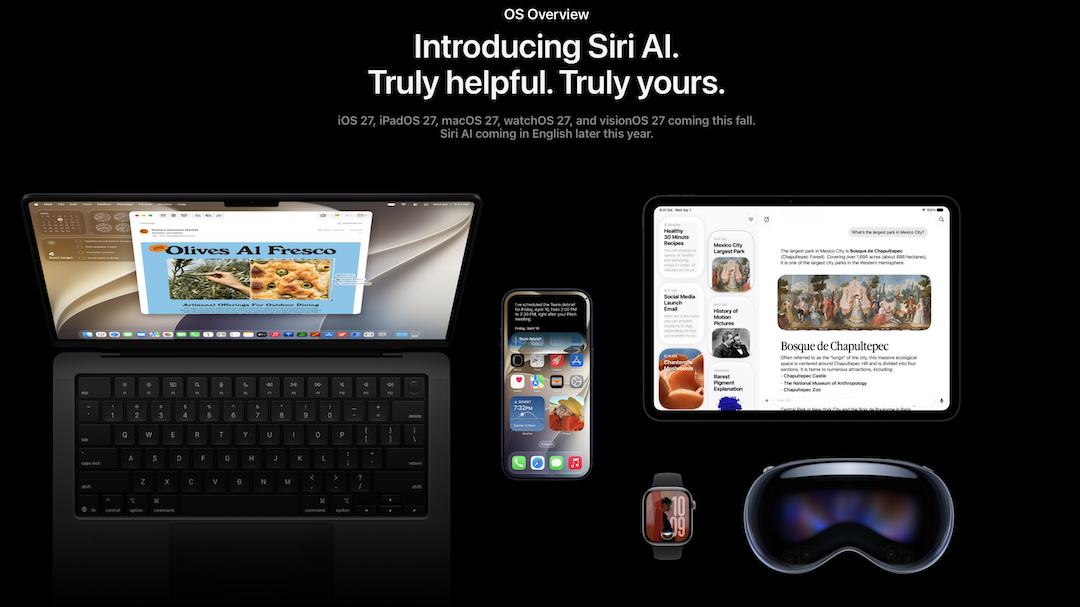
If you stayed up late last night to catch Apple’s WWDC 2026 keynote, you already know it was not a regular event.Yes, there were the usual operating system announcements. Yes, Craig Federighi was up there doing his smooth, rehearsed-but-somehow-still-charming “isn’t this cool?” thing on stage like he always does. But this particular WWDC had two things going on that no other keynote in recent memory has had.First, Apple finally showed up with a real AI assistant, after two full years of delays and broken promises. Second, Tim Cook stood at that podium at Apple Park in Cupertino for what is almost certainly the last time as CEO. Together, those two things made yesterday’s keynote feel different from everything before it.
Let me walk you through everything that happened, what it actually means in practice, and why a few parts of it are worth paying closer attention to than the headlines suggest.Let us just acknowledge the strangeness of this for a moment.
Apple and Google have spent decades building two completely different visions of how people should use technology. They have competed in phones, browsers, maps, email, cloud storage, and digital assistants. These are not two companies that like sharing. And yet, here we are in 2026, with Apple paying Google roughly one billion dollars per year to license a custom version of Gemini so that Siri can finally be smart.
The new Siri, officially rebranded as Siri AI, runs on a custom 1.2-trillion-parameter model that Apple built on top of Google’s Gemini architecture. On the server side, the most demanding queries run on Nvidia Blackwell B200 GPUs hosted inside Google Cloud. Apple calls this component AFM Cloud Pro (Apple Foundation Models Cloud Pro) and says it delivers quality on par with Gemini Frontier-class models.
The privacy architecture is three-layered. Simple, quick tasks stay completely on-device using Apple’s own lightweight foundation models. Medium-complexity requests go through Apple’s Private Cloud Compute infrastructure. Only the most demanding queries, the ones requiring deep reasoning or broad world knowledge, get routed to AFM Cloud Pro in Google’s cloud. Apple says user data is never stored at any layer and that independent researchers can verify this at any time.
Craig Federighi was careful on stage to make the distinction: “The amount of Google Assistant we use is none.” What he means is that the model was trained and tuned by Apple, inspired by and built using Gemini’s architecture, but ultimately Apple’s product. How much weight you give that distinction depends on how you feel about software philosophy, honestly.
One thing Apple did not bring up on stage is the $250 million class action lawsuit it settled just last month with iPhone users who felt cheated because Apple had promised a genuinely intelligent Siri back at WWDC 2024 and never delivered. That settlement, and this announcement, landed in the same calendar month. That is not a coincidence.
After all the background, what changed in practice?
Quite a lot, actually.
Siri AI now has full on-screen awareness. Whatever is visible on your iPhone, a message, an email, a webpage, a photo, Siri can see it too and discuss it with you. You do not need to copy-paste text or explain context. If you are reading a long article and you ask Siri to summarize it or fact-check something in it, it can do that without you switching apps.
There is a standalone Siri AI app now, which is a significant shift from the old bottom-of-screen bar that appeared and disappeared. The new app has a proper chat interface where you can scroll through past conversations. It syncs privately across iPhone, iPad, Mac, and Vision Pro through iCloud. You can come back to something you asked Siri three days ago and continue from there.
Visual Intelligence has been moved from the dedicated Camera Control button (which was exclusive to iPhone 16 hardware and, frankly, something most people rarely used intentionally) into the main Camera app itself. So any user on a supported device can now point their camera at an object, a menu, a plant, a storefront, anything, and ask Siri about it. This was one of those features Apple kept announcing and then making difficult to actually use. Moving it to the Camera app is the right call.
The personal context understanding is also real this time. Siri can search across your messages, emails, photos, calendar, and notes to surface relevant information. “When did I last speak to my brother?” or “Find the photo from my cousin’s wedding in Goa” are the kinds of queries that should actually work now, rather than giving you a generic search result.
The hardware requirements are worth knowing. Siri AI works on iPhone 15 Pro, iPhone 15 Pro Max, and all iPhone 16 models and newer. For the most advanced capabilities, specifically expressive voices and enhanced dictation, you need at minimum an iPhone Air or iPhone 17 Pro. On the Mac side, M3 or M4 machines with at least 12GB of unified memory get the full experience.
Apple continued the version number convention from last year, calling this iOS 27. Every device that runs iOS 26 will run iOS 27. That means support goes all the way back to iPhone 11, with no cuts this cycle. For people holding onto older iPhones, that is good news.
The performance improvements are measurable and real. Apps launch up to 30 percent faster. AirDrop, Mail, and Music see speed boosts of up to 80 percent for certain operations. Photos load up to 70 percent faster in the Photos app. Apple has also rebuilt its CPU scheduler in a way that benefits older devices specifically, so an iPhone 12 or 13 should feel noticeably snappier after the update, not just the new ones.
On the feature side, a few things stand out.
The AirPods custom EQ is one of those features that sounds small but will make a real difference to people who care about sound. iOS 27 finally gives you a three-band equalizer (bass, mids, highs) for AirPods, configurable directly from your iPhone settings. This is something AirPods users have been asking about for years and Apple kept ignoring. It is here now. Better late than never.
The Passwords app is now, functionally speaking, an AI agent. If you have weak or compromised passwords saved in Apple’s Passwords app, it will autonomously navigate to each website, log in on your behalf, and change the password to a stronger one without you having to do anything. Apple did not use the word “agentic” in the keynote but that is exactly what this is. It is also the kind of feature that is worth thinking about carefully before you use it, since it requires giving an automated system access to your actual login credentials. Apple says it all runs locally without data leaving your device, but you decide how comfortable you are with that.
Photos gets three new AI editing tools: Cleanup (remove unwanted objects from a photo), Extend (expand the edges of a frame, similar to generative fill), and Spatial Reframe (reframe and crop videos for different aspect ratios automatically). These were previously scattered across third-party apps. Having them natively in the Photos app makes sense.
Shortcuts got a genuinely practical upgrade. Instead of building automations block by block, you can now describe in plain language what you want a Shortcut to do and iOS 27 will generate one for you. For the vast majority of iPhone users who have never touched Shortcuts because it felt too technical, this removes the barrier entirely.
Safari now uses Apple Intelligence to automatically organize your open tabs into groups, which is useful for anyone who ends up with forty-something tabs by Thursday. It can also monitor specific webpages and notify you when content on them changes, basically a lightweight website watch tool built right into the browser.
iCloud Shared Albums now support full-resolution photo sharing with Android and Windows users. This one has been a pain point in mixed-platform families for years. The photo your family group shares would always be slightly compressed for the non-iPhone members. That changes now.
The Liquid Glass design from last year gets a new transparency slider in Settings, so you can dial back how glass-like and transparent the UI looks if you found the default too busy. It is a customization option that a lot of people complained about not having.
macOS 27 is named Golden Gate. The name sounds nice and it signals something important: this is the first version of macOS that officially drops Intel Mac support. If your Mac runs on Intel, which covers most machines made before late 2020, it will not get macOS Golden Gate. Your machine will still work fine, but this is the last year you will be in the software update conversation.
For Apple Silicon users (M1 and above), Golden Gate brings Siri AI directly into Spotlight search. The Spotlight bar at the top of your screen now has an Ask Siri entry point, so you can ask complex questions without opening the full Siri app. This actually makes a lot of sense for Mac workflows where people tend to use Spotlight heavily.
The design gets tidied up. Apps now share a more consistent toolbar layout across the system, sidebars extend to the edges of the screen to reduce visual clutter, and window corners are slightly tighter. Apple also refreshed app icons again. The changes are visible but not dramatic.
The Search infrastructure underneath was fully rebuilt. New files and downloads start getting indexed almost immediately now, instead of the noticeable lag that used to happen.
watchOS 27 gets full Siri AI integration, which means the same kind of conversational, context-aware queries you can do on your phone now work on your wrist. Workout Buddy, the guided fitness session feature, no longer requires your iPhone to be nearby during use, which is a genuine improvement for anyone who leaves their phone in a locker during workouts. Women’s health tracking in the Health app now includes perimenopause and menopause support with notifications for deviations, something users had been requesting for a long time.
visionOS 27 brings Siri AI into spatial computing. The assistant can now see both your virtual screens and physical surroundings simultaneously. Panorama photos can be converted into full immersive spatial environments, which is a nice creative use of the headset’s capabilities. Wi-Fi connectivity is reportedly up to three times faster. One worth noting: Siri AI is available on Vision Pro in the EU, even though it is not available on iPhone there. That is an inconsistency that Brussels will probably have something to say about eventually.
tvOS 27 got the shortest time on stage by far. The Podcasts app was redesigned, Apple Music gains Hi-Res Lossless audio support, AirPlay connects faster, and on-device HomeKit Secure Video processing was mentioned. That is essentially the whole story for tvOS this year.
This did not get as much coverage as Siri AI, but it is one of the more substantive announcements from a policy standpoint.
Child accounts are now mandatory for anyone under 13 on Apple devices. Parents and guardians can set specific app permissions, control how long children spend in each app individually, and use a new “Ask to Browse” feature that requires their approval before a child visits a new website in Safari. The system automatically applies content filters for nudity and violence on child accounts. Apple also expanded Communication Safety, which was previously limited, to cover a broader range of messaging contexts.
Governments in multiple countries have been pressuring tech platforms hard on children’s screen time and safety for the last couple of years. Apple is responding to that pressure here, but to be fair, a lot of these tools are genuinely useful for parents who have found existing Screen Time settings difficult to manage.
If you are in India, this section is a bit less relevant to you directly. But it matters for the broader picture.
Siri AI is not launching on iPhones or iPads in the European Union. Apple is blaming the Digital Markets Act, an EU regulation that requires Apple to give third-party AI assistants the same deep system access that Siri gets. Apple says it needs more time to build the compliance framework to meet those requirements. The situation is the same in China.
What makes this slightly strange is that Siri AI will be available on Mac, Apple Watch, and Vision Pro in the EU. So a European user can get Siri AI on their MacBook but not on their iPhone. That asymmetry is going to create awkward situations and almost certainly more regulatory back-and-forth over the next year.
For India, the situation looks better. Siri AI will be available here when iOS 27 launches in September. The initial release will be English only. Hindi support has not been officially confirmed on a timeline, but Apple has been investing significantly in the Indian market, and given that Hindi is spoken by hundreds of millions of people, it would be surprising if it took more than a few months after the English launch.
Every major outlet covered this angle and they were right to.
Tim Cook walked out at Apple Park as the last person standing from the original iPhone era of leadership. He has been CEO since 2011. During his tenure, Apple went from a company that was doing well to being the most valuable company on earth for extended stretches. He navigated supply chain challenges that would have broken most organizations, took Apple into new product categories, and managed all of it with a calm that frankly seemed almost unnervingly steady at times.
He steps down on September 1, 2026. John Ternus, the head of hardware engineering, takes over. Cook becomes executive chairman. Notably, Ternus was not on stage at WWDC at all, which makes sense given the conference is fundamentally software-focused and Ternus is a hardware person. Whether his absence signals anything about Apple’s direction is something people will debate.
Cook’s closing words were: “Getting the best products in the world to deliver experiences that enrich people’s lives has always been our North Star. It’s been the honour of a lifetime to help advance that mission with teams whose creativity, care, and conviction continue to make a lasting difference in people’s lives.”
Multiple reporters in the room noted that Cook appeared visibly emotional. That is not surprising, honestly. Fifteen years is a long time. WWDC, more than any other Apple event, is the one where you see developers, people who have built careers and products around Apple’s platforms, all gathered together. For someone who has spent so many years at this particular intersection of technology and creativity, that is a genuinely emotional room to be standing in for the last time.
Apple’s stock, for what it is worth, was up about 2 percent at the start of the keynote and then slid back into negative territory as the presentation went on. The market’s read appears to be that the Gemini partnership raises questions about Apple’s long-term AI independence. That is a fair concern.
If you are on an iPhone 15 Pro or newer, the iOS 27 update in September is worth looking forward to. Performance gains on iOS are often overstated but the numbers Apple quoted here are large enough that daily usage will feel different. Siri AI will actually be useful in ways the old Siri was not. The Photos editing tools, AirPods EQ, and Shortcuts language mode are all practical improvements.
If you are on an older iPhone (11 through 14), you get iOS 27 and the speed improvements, which is genuinely good. Siri AI will not be available because of hardware requirements, but the core experience will feel faster.
If you are on a Mac with Apple Silicon, macOS Golden Gate is a solid update with the Siri AI in Spotlight being the standout addition.
Developer betas of everything are available today. Public betas are expected in July 2026. Official releases come in September alongside iPhone 18.
Apple had a lot to prove at WWDC 2026. After two years of missing AI deadlines, a class action settlement, and a growing narrative that the company was falling behind on intelligence, yesterday’s keynote was their counter-argument. Siri AI is not perfect yet. The dependency on Google for cloud inference is a strategic irony that will be written about for years. The EU situation is messy. But what was shown on stage yesterday looks genuinely competitive for the first time in a while.
That is not nothing. Especially from a company that spent a decade telling everyone privacy and on-device processing were the only way forward, and then signed a billion-dollar deal with its largest competitor to make its assistant actually useful.
Apple is not the same company it was last year. Let’s see where Ternus takes it from here.
| What | Details |
|---|---|
| iOS 27 developer beta | Available now (June 8, 2026) |
| iOS 27 public beta | Expected July 2026 |
| iOS 27 official release | September 2026 |
| Siri AI beta | September 2026, English first |
| Siri AI hardware minimum | iPhone 15 Pro, iPhone 16, iPad M1+, Mac M1+ |
| Advanced Siri AI features | Requires iPhone Air, iPhone 17 Pro, or M3/M4 Mac with 12GB RAM |
| macOS Golden Gate | Apple Silicon (M1 and above) only |
| Siri AI availability | Not on iPhone/iPad in EU or China at launch |
| iOS 27 device support | iPhone 11 and newer (no cuts from iOS 26) |
| Tim Cook steps down | September 1, 2026 (John Ternus takes over) |
Written from Pune, India. All product names and trademarks are the property of their respective owners.
Three men who genuinely do not like each other agreed on something this weekend. That…
Apple usually gives Indian buyers one small consolation at launch time. New phone comes in…
Michelin started selling the Primacy 5 in India on 3 August. It is the first…
At around 2 pm on Saturday, 25 July, police fired tear gas shells at protesters…
Last Updated: 24th July 2026:- Something strange has happened in Indian politics this year. A…
If you hold an engineering diploma and have ever considered serving the nation in uniform,…