
Apple usually gives Indian buyers one small consolation at launch time. New phone comes in at the top, last year’s model drops a few thousand, and everyone finds something in their budget. That did not happen this year.
The iPhone 18 Pro price in India starts at Rs 1,64,900 for the 256GB variant, and the iPhone 18 Pro Max starts at Rs 1,79,900. That is roughly Rs 30,000 more than what the iPhone 17 Pro asked for last September. Then Apple did something it almost never does. Within hours of the keynote ending, the iPhone 17, iPhone Air, iPhone 17e and even the two year old iPhone 16 all got more expensive on the India store.
So this is not a normal launch roundup. Below is everything Apple announced at its Surprise and Shine event on 9 September 2026, the confirmed India prices, the dates you need to remember, and an honest look at whether any of it is worth the money right now.
Apple Surprise and Shine event 2026: what actually launched
The keynote ran from Apple Park in Cupertino at 10 AM Pacific, which was about 10:30 PM IST. It was the first one hosted by John Ternus, who took over as CEO from Tim Cook on 1 September. Cook stays on as executive chairman.
Here is the full list of what came out of it:
- iPhone 18 Pro and iPhone 18 Pro Max
- iPhone Duo, Apple’s first ever foldable iPhone
- Apple Watch Series 12
- Apple Watch Ultra 4
- AirPods 5
- iOS 27, iPadOS 27, watchOS 27 and macOS 27 Golden Gate, all releasing 14 September
And one big absence. There is no regular iPhone 18 this year. Apple has split the lineup into two launches, so the standard iPhone 18, the iPhone 18e and the iPhone Air 2 are expected only in the first half of 2027. If you were waiting for the affordable flagship, you are waiting another six months at least.
iPhone 18 Pro and Pro Max: what actually changed
Pick up an iPhone 18 Pro next to a 17 Pro and you will struggle to tell them apart from a distance. Same 6.3 inch and 6.9 inch screen sizes, same general shape, same button layout. Almost everything interesting is on the inside.
The camera is the headline, and it is a genuine first
The 48MP main camera now has a mechanical variable aperture. Six laser cut blades physically open and close to move the aperture between roughly f/1.48 and f/4. Phone cameras have faked depth of field with software for a decade. This one actually changes the optics.
In practical terms it means two things. In low light the lens opens all the way to pull in more light, so you get cleaner night shots without leaning as hard on computational stacking. In bright daylight it stops down, which gives you sharper edge to edge detail and lets you shoot longer exposures without blowing out the frame. Anyone who has tried to get that silky waterfall effect on a phone in daytime will understand why this matters.
Apple has also added manual aperture and shutter speed controls inside the Camera app, and opened an API so third party camera apps can use the full aperture range. Halide and Kino users are going to have fun with this.
The rest of the camera system stays close to last year. Triple 48MP setup with ultra wide and telephoto, LiDAR, plus an updated image pipeline, new grain and texture controls in Photographic Styles, and post capture Cinematic mode adjustments at up to 60fps.
A20 Pro: the first 2nm iPhone chip
The A20 Pro is built on TSMC’s 2 nanometre process, which makes it the first 2nm chip in any iPhone. Apple is quoting a 7 core GPU that is up to 40 percent faster than the A19 Pro, along with a 32 core Neural Engine.
The more interesting part is thermal. Apple redesigned the vapor chamber with about three times the surface area of the one in the iPhone 17 Pro, and claims roughly 40 percent better sustained performance. Sustained is the key word. Peak benchmark numbers have never been the iPhone’s problem. Holding those numbers through a twenty minute 4K recording in Pune summer heat is a different story, and that is what the bigger chamber is trying to fix.
Battery numbers are up too. Apple rates the Pro Max at up to 45 hours of video playback and the Pro at up to 36 hours, with wired charging hitting 50 percent in around 15 minutes. Both models also ship with Apple’s own C2 modem, which finally pushes Qualcomm out of the Pro line entirely.
Design, display and colours
The Dynamic Island has shrunk noticeably this year, and the redesigned version can show up to three Live Activities at once. Full under display Face ID did not arrive, despite months of supply chain chatter suggesting it would.
Displays stay at 6.3 inch and 6.9 inch Super Retina XDR with ProMotion up to 120Hz, protected by Ceramic Shield 2. Colours are Black, Silver, Glacier and a new Burgundy, which is the one Apple clearly wants you to notice.
iPhone 18 Pro price in India: full variant list
Pre-orders opened in India on 12 September at 5:30 PM IST. Sales and deliveries begin on 18 September, with India in the first wave alongside the US, UK, Canada, Japan, Germany and around 60 other markets.
| Model | Storage | India price | US price |
|---|---|---|---|
| iPhone 18 Pro | 256GB | Rs 1,64,900 | $1,199 |
| iPhone 18 Pro | 512GB / 1TB / 2TB | Higher tiers, up to Rs 3 lakh plus | Scaled up |
| iPhone 18 Pro Max | 256GB | Rs 1,79,900 | $1,299 |
| iPhone 18 Pro Max | 2TB | Around Rs 3,29,900 | $2,499 |
Yes, the top spec iPhone 18 Pro Max costs more than a Royal Enfield Classic 350 with a full tank. The internet noticed.
Launch offers worth checking before you tap buy:
- Up to six months of no cost EMI through select banks
- Instant cashback of up to Rs 7,000 on eligible American Express, Axis Bank and ICICI Bank cards
- Apple Trade In credit of up to Rs 81,500, depending entirely on your old device and its condition
- Three months of Apple Music, Apple TV+ and Apple Arcade with eligible purchases
Stack the cashback and a decent trade in and the effective price drops meaningfully. Without them, the sticker is brutal.
iPhone Duo: the first foldable iPhone, and India pays the most
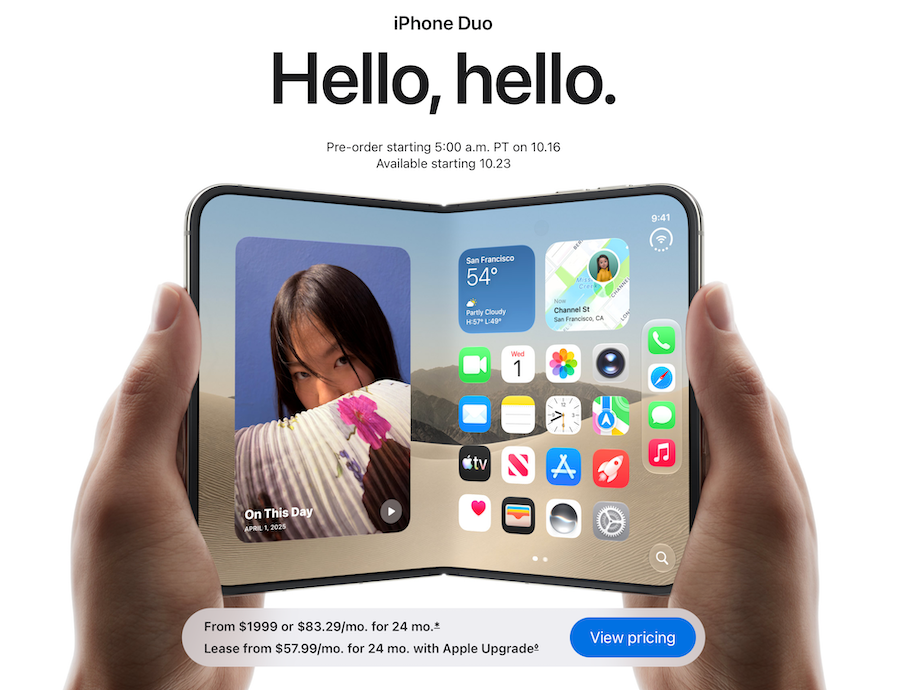
This was the actual surprise. After years of watching Samsung, Huawei, Google and Motorola iterate on folding phones, Apple finally shipped one. The name is iPhone Duo, not iPhone Ultra or iPhone Fold, which is what most leaks had been calling it.
It folds like a book. Closed, you get a 5.4 inch cover display that Apple says covers more than 90 percent of the screen area of an iPhone 18 Pro, so it is a usable phone on its own rather than a token outer panel. Open it and you get a 7.6 inch inner Super Retina XDR display with roughly 50 percent more screen area than an iPhone 18 Pro Max.
Key specs and trade offs:
- Same A20 Pro chip as the iPhone 18 Pro
- Touch ID built into the side button instead of Face ID
- Custom nano texture finish on the inner panel to reduce both reflections and the visibility of the crease
- Ceramic Shield on the outer display and the back panel
- eSIM only, with Apple saying the removed SIM tray freed up space for battery
- Up to 44 hours of video playback on the cover screen, 31 hours on the inner display
- MagSafe and Qi2 wireless charging up to 25W
- No telephoto lens, which is a real omission at this price
- Colours: Star White and Night Sky
iPhone Duo price in India
| Storage | India price |
|---|---|
| 256GB | Rs 2,99,900 |
| 512GB | Rs 3,24,900 |
| 1TB | Rs 3,74,900 |
| 2TB | Rs 4,49,900 |
Pre-orders open on 16 October at 5:30 PM IST, with sales starting 23 October in more than 70 countries including India. A further 28 markets get it from 30 October.
For context, the iPhone Duo costs $1,999 in the US, which converts to roughly Rs 1,90,000. India is paying close to 58 percent more. A large part of that is because the Duo is not assembled locally, so it attracts the full import duty on top of 18 percent GST. Counterpoint Research’s Tarun Pathak has pointed to a 20 percent import duty on the foldable for exactly this reason. Prabhu Ram of CyberMedia Research has called it an uber premium tier sitting above the Pro series, likely to stay a halo product for a while rather than a volume seller.
Samsung’s Galaxy Z Fold 8 currently sells in India around Rs 1,79,999. Apple is asking for Rs 1.2 lakh more.
Apple Watch Series 12 and Apple Watch Ultra 4
Both watches move to the new S11 chip and run watchOS 27.
Apple Watch Series 12 brings a new Health Sensing System that reads heart rate every five seconds, along with a Readiness score, redesigned step tracking, more detailed strength workout tracking and the new Audio Intelligence features. The ceramic case is back as an option.
India pricing starts at Rs 56,900 for the 42mm and Rs 62,900 for the 46mm in aluminium. Titanium models start around Rs 99,900, and the ceramic editions go up to Rs 1,24,900 and Rs 1,30,900. Aluminium finishes are dark bronze, black, light gold and space grey. Titanium comes in radiant gold and natural titanium, and ceramic in pearl white and night blue.
Apple Watch Ultra 4 starts at Rs 1,09,900, with the titanium Milanese Loop version at Rs 1,24,900. It shares the health sensing upgrades and adds the thing Ultra buyers actually want, which is battery life. Apple is quoting up to 50 hours of normal use and up to 84 hours in low power mode. Available in natural and black titanium.
Both are on pre-order now with in store availability from 18 September.
AirPods 5: the most interesting value pick of the launch
The AirPods 5 might be the only product here that gets cheaper to justify. Apple has brought Active Noise Cancellation to its open ear design and claims it removes up to 50 percent more external noise than the AirPods 4. There is a new multiport acoustic architecture and a next generation Adaptive EQ behind that claim.
Feature wise you get hands free Siri AI, Live Translation powered by Apple Intelligence, Adaptive Audio and Conversation Awareness. Live Translation is limited to selected languages and regions at launch, so check before you assume Hindi or Marathi support on day one.
Battery is rated at up to four hours with ANC on the standard model, five hours on the version with the wireless charging case, and up to 22 hours total with the case. Both use USB-C.
India pricing is Rs 14,900 for AirPods 5, and Rs 17,900 for AirPods 5 with the Wireless Charging Case. On sale from 18 September.
iOS 27 release date and the Siri AI overhaul
iOS 27 arrives on Monday, 14 September, four days before the new phones reach stores. iPadOS 27, watchOS 27 and macOS 27 Golden Gate land the same day. It is a free update.
The headline is Siri AI, the rebuilt assistant Apple first showed at WWDC in June. This is not a few new voice commands. Siri now lives in its own app with conversation history, accepts typed input, handles follow up questions, and can pull personal context from Messages, Mail, Journal and other supported apps. It is wired into Spotlight, and Visual Intelligence now runs through a dedicated Siri mode in the Camera app so you can hand it screenshots and captured images as context.
A few limits worth knowing before you update:
- Siri AI launches in beta and in English only. French, Japanese, Korean, Portuguese and Spanish are expected in October.
- iOS 27 itself supports iPhone 11 and later plus the second generation iPhone SE, but Siri AI needs an iPhone 15 Pro, 15 Pro Max, or an iPhone 16 or newer.
- Newer chips get a stronger on device model, so speech recognition and dictation will be noticeably better on recent hardware.
- Some advertised features are not in the day one build. Automatic password fixing and Messages suggestions are listed for a later update.
Beyond Siri there are Liquid Glass design refinements with new contrast controls, expanded parental and child safety controls, a new iPhone Handoff feature, updated Find My location hiding options, Photos gaining Extend and Spatial Reframe, and general performance work.
What Siri AI actually means for your data
This is the part most launch coverage skips, and it is the part worth thinking about for five minutes before you enable everything.
Siri AI gets meaningfully broader access to your personal context. Messages, Mail, Journal, on screen content, and now third party apps can feed it information to answer your queries. That is exactly what makes it useful, and it is also a much larger blast radius than old Siri ever had.
Apple’s stated architecture is still on device processing first, with Private Cloud Compute handling requests that need more horsepower. That is a better privacy posture than most assistants on the market. But two things are new this year. Apple has confirmed it partnered with Google and used Gemini models in training the technology behind Siri AI. And the assistant is shipping as a beta, which historically means behaviour changes between builds.
Practical advice if you care about this: after updating, go through Settings and review which apps are allowed to provide Siri with information, and decide app by app rather than leaving the defaults on. On a work phone, check with your IT or security team before you point a context hungry assistant at corporate mail. Both of those take two minutes and save you a conversation you do not want to have later.
Why iPhones got so expensive in India this year
The Rs 30,000 jump on the Pro is not Apple being greedy in isolation. Several things landed at once.
The biggest is memory. DRAM and NAND prices have gone vertical through 2026 as AI datacentre demand soaks up supply. Analysts at TrendForce projected memory acquisition costs for the iPhone 18 Pro rising close to 400 percent year on year in Q3 2026. The industry has started calling it RAMageddon, only half jokingly. Tim Cook had already flagged in June that the company could not keep absorbing component costs indefinitely.
Add the 2nm process, which is more expensive per wafer than 3nm, and the base cost goes up before anything ships.
Then India adds its own layers. GST at 18 percent, duties on imported components, a weaker rupee, and distribution economics. This is why the US saw around a 9 percent increase on the Pro while India saw roughly 22 percent. Counterpoint’s Tarun Pathak has put Indian price increases at 20 to 30 percent against a global average of 8 to 10 percent.
The Made in India question comes up every year, and the answer is the same. Apple assembles a lot of iPhones here now, through Foxconn, Pegatron and the Tata Group, with something like 55 million units produced in India in 2025. But assembly is not localisation. Industry estimates put domestic value addition on India assembled iPhones at around 20 percent, with the expensive components still arriving through global supply chains. Assembling here removes some cost, not most of it.
The older iPhones got costlier too
This is the part that genuinely broke pattern. Instead of the usual price cut, Apple revised existing models upward on the India store.
| Model | Old price | New price | Change |
|---|---|---|---|
| iPhone 17 (256GB) | Rs 82,900 | Rs 99,900 | +Rs 17,000 |
| iPhone 17 (512GB) | Rs 1,02,900 | Rs 1,24,900 | +Rs 22,000 |
| iPhone Air (256GB) | Rs 1,19,900 | Rs 1,49,900 | +Rs 30,000 |
| iPhone Air (512GB) | Rs 1,39,900 | Rs 1,74,900 | +Rs 35,000 |
| iPhone Air (1TB) | Rs 1,59,900 | Rs 2,24,900 | +Rs 65,000 |
| iPhone 17e | Rs 64,900 | Rs 79,900 | +Rs 15,000 |
| iPhone 16 (128GB) | Rs 69,900 | Rs 89,900 | +Rs 20,000 |
The iPhone Air took the worst of it, with the 1TB variant up 40.6 percent. Across the India catalogue, increases run from about 20 percent to over 40 percent.
There is a real commercial risk here. Counterpoint expects Apple’s India shipments to slip to a single digit decline in 2026, down from 14.3 million units in 2025. India’s overall smartphone average selling price has been climbing, so premiumisation is still working as a trend. But there is a difference between buyers trading up to Rs 80,000 and buyers being asked for Rs 1.65 lakh.
Should you buy now, or wait?
A few honest scenarios.
You are on an iPhone 15 Pro or older. The 18 Pro is a real generational jump. New chip node, variable aperture, much better sustained performance, big battery gains. If the budget works, this is the natural upgrade.
You are on an iPhone 17 Pro. Skip it. You are paying Rs 1.65 lakh for a variable aperture and better thermals. The 17 Pro camera is still excellent and will be for another two years.
You wanted the regular iPhone 18. It is not coming until 2027. Your realistic options are an iPhone 17 at its new higher price, or waiting.
You are tempted by the iPhone Duo. First generation foldables from any manufacturer have historically had hinge and crease issues that only show up after six months of daily use. At Rs 2,99,900 with no telephoto lens, I would let other people be the beta testers on this one. Revisit after the first proper teardowns and long term reviews land in November.
You just want the new AI stuff. You do not need a new phone. iOS 27 with Siri AI is free and runs on the iPhone 15 Pro and newer. Update on 14 September and see whether the assistant is actually useful to you before spending anything.
If you are buying anyway, wait for the festive season. Bank offers, exchange bonuses and marketplace discounts around Diwali usually beat launch day pricing by a decent margin, and supply will have settled by then.
Frequently asked questions
What is the iPhone 18 Pro price in India? The iPhone 18 Pro starts at Rs 1,64,900 for the 256GB variant. The iPhone 18 Pro Max starts at Rs 1,79,900 for 256GB, and the top 2TB Pro Max is priced at around Rs 3,29,900.
When does the iPhone 18 Pro go on sale in India? Pre-orders opened on 12 September 2026 at 5:30 PM IST. Sales and deliveries begin on 18 September 2026 through the Apple India online store, Apple Stores, authorised retailers and major online platforms.
Is there a regular iPhone 18 this year? No. Apple has split its launch cycle. Only the iPhone 18 Pro, iPhone 18 Pro Max and iPhone Duo launched in September 2026. The standard iPhone 18, iPhone 18e and iPhone Air 2 are expected in the first half of 2027.
What is the iPhone Duo price in India? The iPhone Duo starts at Rs 2,99,900 for 256GB, Rs 3,24,900 for 512GB, Rs 3,74,900 for 1TB and Rs 4,49,900 for 2TB. Pre-orders begin 16 October 2026 and sales start 23 October 2026.
When is the iOS 27 release date? iOS 27 releases on 14 September 2026 as a free update, along with iPadOS 27, watchOS 27 and macOS 27 Golden Gate.
Which iPhones support Siri AI in iOS 27? Siri AI requires an iPhone 15 Pro, iPhone 15 Pro Max, or an iPhone 16 or newer. iOS 27 itself installs on the iPhone 11 and later plus the second generation iPhone SE, but older models will not get Siri AI.
Why are iPhones so much more expensive in India than in the US? A combination of 18 percent GST, duties on imported components, a weaker rupee and distribution costs. On top of that, a global memory chip shortage and the more expensive 2nm manufacturing process pushed base costs up worldwide in 2026.
What is the AirPods 5 price in India? AirPods 5 are priced at Rs 14,900, and the version with the Wireless Charging Case costs Rs 17,900. Both go on sale from 18 September 2026.