Every result season, thousands of AKTU students ask the same questions. Will I get grace marks? How many? What does PWG mean on my result? Will it affect my degree?
The confusion is understandable, AKTU has changed its grace marks rules multiple times since 2016, and a lot of the information floating around online is outdated. This guide covers the complete, current grace marks rules for 2025-26, explains the difference between the old and new system, and tells you exactly where you stand based on your admission year.
Why There Is So Much Confusion About AKTU Grace Marks
The original AKTU grace marks rule announced in 2016-17 talked about a total of 40 marks grace across a B.Tech degree. That rule applied to non-CBCS students and created a lot of discussion at the time. Engineers Corner covered it extensively and thousands of students came here for clarity.
But AKTU moved to CBCS (Choice Based Credit System) starting from the 2016-17 academic session. Under CBCS, the grace marks structure is completely different. Many students, especially those from 2019 onwards are still searching for “40 marks grace rule” when that rule no longer applies to them directly. Understanding which system you fall under is the first step.
Step 1 :- Which System Do You Fall Under?
Before anything else, identify your admission year:
If you were admitted in 2015-16 or earlier, you are under the Non-CBCS system. The older grace marks structure applies to you. Contact your college registrar or AKTU office for your batch-specific rules since these are handled case by case for older batches.
If you were admitted in 2016-17, 2017-18, you are under CBCS (first wave). Maximum grace marks: 7 marks per academic year for B.Tech, B.Pharm, BFAD, BFA, BHMCT, MCA, MBA. For M.Tech, M.Pharm, M.Arch: 5 marks per year.
If you were admitted in 2018-19 or later, you are under CBCS (updated ordinance). Maximum grace marks: 10 marks per academic year for B.Tech, MBA, MBA(I). This is the rule that applies to most current students in 2025-26.
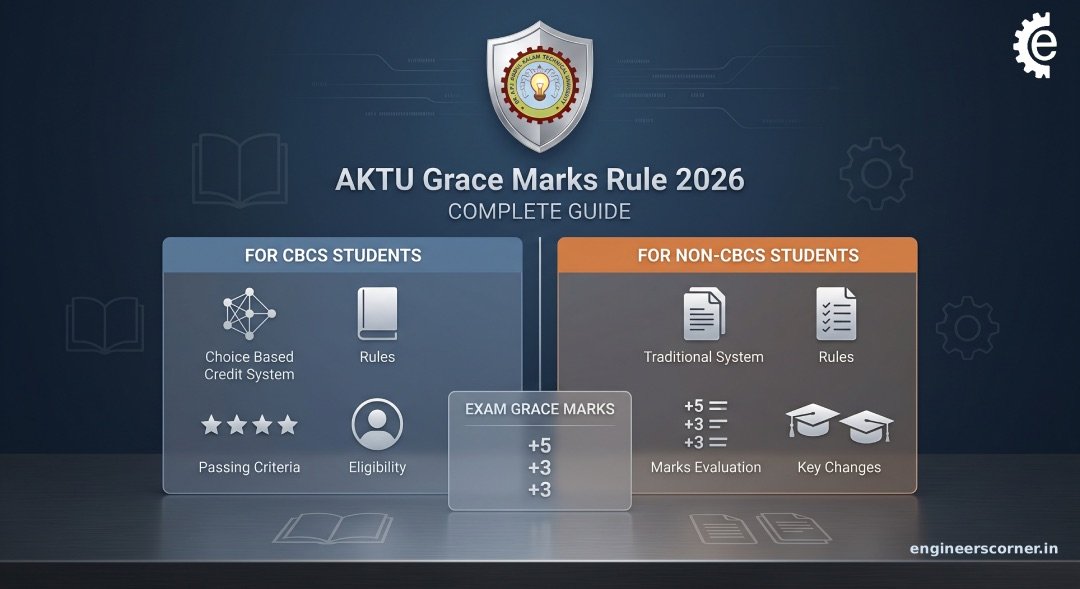
How AKTU Grace Marks Work in 2025-26
The grace marks system under CBCS works differently from what many students expect. Here is how it actually works:
Grace marks are applied automatically by AKTU after result processing, you do not need to apply for them separately. The university calculates whether you are within the eligible range and applies grace accordingly.
The maximum limit for most current batches is 10 marks in a single academic year. These marks can be split across multiple subjects, for example, 6 marks in one subject and 4 marks in another, provided the total does not exceed 10 for that year.
Grace marks are awarded only if they result in you actually passing the year. If your shortfall is more than the maximum allowed grace for your batch, grace marks will not be applied, you will need to appear in the carry over exam instead.
Grace marks are not applicable for MOOCs, audit subjects, or lateral entry qualifying subjects. They apply only to regular theory papers under the CBCS system.
What Happens to Your Result After Grace Marks
This is where most students get confused. When AKTU applies grace marks, two things change in your result:
Your One View status changes to PWG: Pass with Grace. This means you are officially “Pass” for the year and you do not need to give a back paper for the subject where grace was applied. PWG is a clean promotion, it does not mean you have a backlog.
Your grade card shows “E” grade: When grace marks are awarded, AKTU gives the student a grade “E” for that subject on the marksheet, indicating the subject was passed using grace marks. On some marksheets, the subject may also show a hashtag or asterisk next to the marks (like 30#) indicating adjustment to the passing threshold.
Credit normalization : If a student passes all subjects but SGPA is slightly below 5.0, AKTU allows credit normalization of up to 0.25 to declare the student as PASS for that academic year. This is a separate provision from grace marks and applies to borderline SGPA cases.
Grace Marks Cannot Be Carried Forward
This is a critical rule many students miss. Grace marks cannot be carried forward. If the marks are not availed in a particular academic year, they lapse. You cannot save unused grace marks from 2nd year to use in 3rd year. Each year’s grace marks limit is fresh but also limited to that year only.
Can You Withdraw Grace Marks?
Yes, and this surprises most students. Students can withdraw grace marks within 60 days by submitting a notarized affidavit to the university. Once withdrawn, they must reappear in the subject’s next exam, and grace cannot be restored later.
Why would anyone want to withdraw grace? Some students prefer a clean marksheet without the PWG or E grade notation, particularly those planning to apply for PSU jobs or higher studies where marksheet scrutiny is strict. If you fall in this category and your shortfall was small, consider whether a clean marksheet matters more to you than the PWG status.
What If Grace Marks Don’t Cover Your Shortfall?
If your marks shortfall is more than the grace limit for your batch, you will be given PCP status, Promoted with Carry Over Paper. PCP means you have moved to the next year but must clear the backlog subject in the upcoming odd or even semester carry over exams.
You fill the carry over form through the AKTU ERP portal. The carry over exam is held alongside the next semester’s regular exams. The higher marks from any attempt, original or carry over are considered in your final result.
Challenge Evaluation:- If You Think Your Paper Was Marked Wrong
If your result doesn’t reflect your performance, you have the right to challenge it. Apply on AKTU ERP within the specified window after result declaration, paying ₹300 per subject. After a few weeks, a PDF of your checked answer script becomes available on your ERP dashboard. Check for unchecked questions or totaling errors.
If you find significant mistakes, proceed to Stage 2, re-evaluation by two new external examiners who recheck your entire paper from scratch. Challenge Evaluation is an underused option. If you are genuinely confident about your performance, it is worth pursuing.
Grace Marks by Course and Batch:- Quick Reference
For B.Tech, B.Pharm, BFAD, BFA, BHMCT, MCA, MBA admitted in 2016-17 or 2017-18, maximum 7 grace marks per year.
For M.Tech, M.Pharm, M.Arch admitted in 2016-17, maximum 5 grace marks per year.
For B.Tech, MBA admitted in 2018-19 onwards , maximum 10 grace marks per year.
For B.VOC admitted in 2019-20, maximum 3 grace marks per year.
For M.Tech(I) admitted in 2019-20, maximum 7 grace marks per year.
For B.Pharm and M.Pharm under PCI ordinance from 2019-20, 7 and 5 grace marks per year respectively.
For the official ordinance specific to your batch and course, always verify at aktu.ac.in or through your college registrar.
Common Questions Students Ask
How long does it take for grace marks to be updated in One View? Grace marks are typically updated within 1 to 2 weeks after result declaration. If your result hasn’t updated after two weeks, contact your college registrar with your roll number and a written application.
Will PWG status affect my placement or PSU application? For most campus placements, PWG status does not disqualify you, companies look at your overall CGPA and marks. However, some PSUs and government jobs conduct strict marksheet scrutiny. If this is a concern, consider the withdrawal option within 60 days.
Can I get grace marks in internal back? The CBCS grace marks primarily apply to theory paper shortfalls in end semester exams. Internal backs are generally handled separately. Consult your college registrar for your specific situation.
My result still shows F status even after two weeks, what to do? First check whether your marks meet the minimum 15% threshold required for grace eligibility. If you believe you are eligible but grace hasn’t been applied, submit a written application to your college registrar, who will forward it to AKTU examination branch.
Can grace marks be applied to improve CGPA? No. Grace marks are applied only to help you pass a subject, they push you to the minimum passing threshold and show as grade E. They do not improve your CGPA beyond the passing grade.
Related Articles on Engineers Corner
For the original 2016-17 AKTU grace marks announcement and the 40 marks rule for older non-CBCS batches – read our complete guide here.
For the official AKTU circular on grace marks for final year students – read the full circular coverage here.
Always verify the latest rules at the official AKTU website: aktu.ac.in. Grace marks rules are updated periodically through official ordinance circulars and your batch-specific rules take precedence.