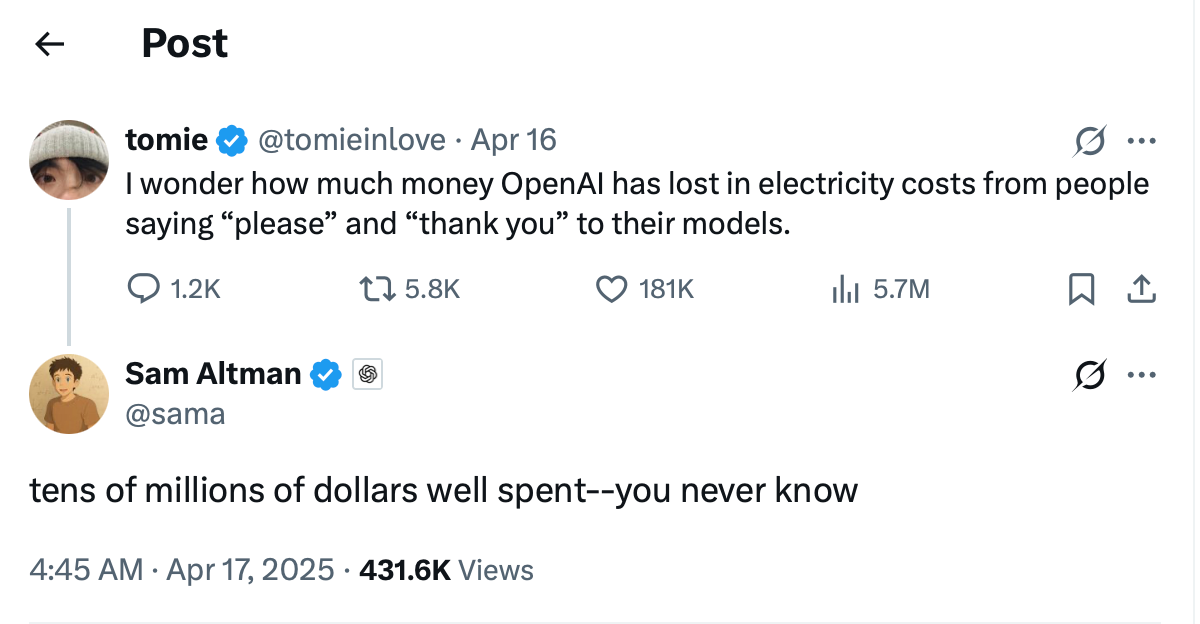
OpenAI CEO Sam Altman says the company spent “tens of millions” of dollars on electricity costs due to users saying “please” and “thank you” to AI models. But he believes it’s money well spent. Here’s why it matters.
In a lighthearted yet insightful moment on X (formerly Twitter), Sam Altman, the CEO of OpenAI, responded to a curious user who asked:
“I wonder how much money OpenAI has lost in electricity costs from people saying ‘please’ and ‘thank you’ to their models.”
Sam’s reply?
“Tens of millions of dollars well spent—you never know.”
Yes, you read that right. OpenAI has apparently spent tens of millions of dollars processing polite phrases like “please” and “thank you” through its AI models — and Sam Altman thinks it’s absolutely worth it.
The post instantly sparked reactions from users across the platform. Some found it hilarious, others philosophical, and many saw it as a testament to the human habit of anthropomorphizing technology. While AI doesn’t need manners, it’s interesting (and kind of wholesome) that so many people still treat it with basic human courtesy.
This interaction, though brief, highlights something deeper about how we interact with AI — and how those interactions, even polite ones, have real-world costs.
Even though AI doesn’t have feelings, there’s something to be said about how politeness shapes our behavior. Being polite to AI might help reinforce empathy, especially for younger users growing up with AI-integrated tools. And from a training perspective, every bit of user input helps improve natural language understanding.
So while “please” and “thank you” may technically cost more to process, they might also encourage a more respectful and thoughtful digital culture. Maybe that’s what Sam Altman meant by “you never know.”
This tweet also sheds light on the often-overlooked cost of running large language models. Every prompt, every token processed, and every second of response time consumes electricity which, at OpenAI’s scale, translates into millions of dollars in energy bills.
With millions of users chatting with ChatGPT and GPT-4 daily, even small habits like using polite language contribute to compute cycles. Multiply that by billions of interactions per month, and you’ve got a recipe for some serious electricity usage.
It’s wild to think that our everyday habits – even polite ones – can ripple all the way into OpenAI’s electricity bill.
But what do you think?
Should we teach AI to ignore filler words and niceties to save power, or is it worth keeping the human touch alive in our digital conversations?
Drop your thoughts in the comments below – do you still say “please” to ChatGPT?
Three men who genuinely do not like each other agreed on something this weekend. That…
Apple usually gives Indian buyers one small consolation at launch time. New phone comes in…
Michelin started selling the Primacy 5 in India on 3 August. It is the first…
At around 2 pm on Saturday, 25 July, police fired tear gas shells at protesters…
Last Updated: 24th July 2026:- Something strange has happened in Indian politics this year. A…
If you hold an engineering diploma and have ever considered serving the nation in uniform,…